

 Bonani DOSH, Dhaka - 1230, Bangladesh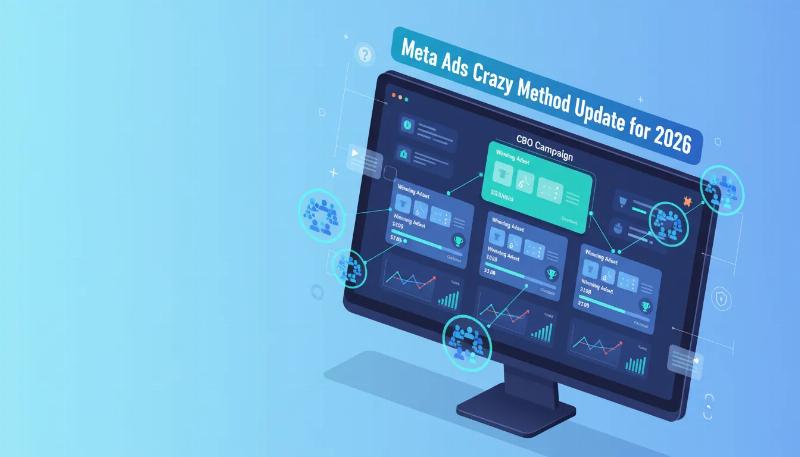

Meta Ads Crazy Method Update for 2026
Why the Crazy Method still matters in 2026
The Crazy Method is my go-to scaling technique because it amplifies something that already works instead of trying to fix something that doesn’t. In 2026, with new algorithm updates and Advantage Sales Campaigns, the method still works—when used correctly. It is not a miracle cure for unprofitable adsets. It is a scaling amplifier and a risk management tool when you have a clear winner to scale from.
What the Crazy Method actually is
At its core, the Crazy Method duplicates a winning adset multiple times inside a CBO campaign to target different "hot pockets" of users. Each duplicate keeps the same demographic, interest (or broad targeting), placements, and creatives, but it acts like several parallel experiments inside the same campaign.
Two non-negotiables:
- Always run as CBO. The Crazy Method is a CBO-only approach.
- Use it to scale winners only. Don’t try to make a bad adset profitable with duplication—this is a scaling tactic, not a rescue mission.
Why it works: hot pockets and initial randomness
The Meta algorithm optimizes toward the type of person who converts first. Because initial converters are somewhat random, duplicating an adset increases the chance each duplicate will attract a different “hot pocket”—a group of similar users who respond well to that creative and offer.
Example mental model: one early converter might be a 30-year-old who loves cigars and marketing; another might be a 45-year-old who prefers Google Ads. Each early conversion pulls the algorithm toward similar profiles. The Crazy Method intentionally multiplies those chances so the campaign can discover multiple profitable pockets faster.
How to implement the Crazy Method (step-by-step)
- Identify a clear winner: an adset that has consistent volume and profitable metrics (for example, a ROAS comfortably above break-even for several days).
- Create a CBO campaign and duplicate that winning adset multiple times. Minimum duplicates: 3. Preferred: 4–10.
- Size your total CBO budget based on the adset’s current performance. Use the adset’s average cost per purchase (CPA) as a guide to ensure each duplicate has enough budget to enter the learning and conversion cycle.
- If you exceed about 10 adsets, reduce per-adset budgets (for example, halve them) so each adset still gets meaningful delivery.
- Monitor for cannibalization and creative overlap. If the same creative is used across many duplicates, you raise the risk of campaigns competing against each other.
Example scenario (practical)
Suppose a baseline adset spends $200/day, returns ~4 purchases/day, and CPA is $50. If you want to scale with the Crazy Method, plan a CBO budget that gives each duplicate enough budget to reach similar volume. Start with 3–5 duplicates and split the total CBO budget so each adset has reasonable delivery. If you add more than 10 duplicates, lower the per-adset budget to keep performance stable.
When to use the Crazy Method—and when not to
- Use it when you have an adset with stable volume and profitable ROAS/CPA that you want to scale safely.
- Do not use it when the adset is marginally profitable (barely above breakeven) or inconsistent—this approach can burn budget without improving ROI.
- Works well for e-commerce stacks and dropshipping (especially clothing) where multiple product types need different hot pockets.
- Less useful for single-product funnels where multiple creative angles should be tested inside a single adset/CBO focusing on creative variation instead of duplicating adsets.
Common mistakes and risks
- Abuse by blind duplication: Repeating the same adset across many campaigns with identical creatives will eventually cause problems. It can work short-term, but long-term it risks account instability and wasted spend.
- Cannibalization: Multiple campaigns or adsets selling the same product with the same creative can compete against each other and drive up costs.
- Not knowing CBO optimization: The Crazy Method requires at least intermediate knowledge of how CBO allocates budget and how the algorithm learns.
- Scaling marginal winners: If your baseline adset is only slightly profitable, duplicating it will likely magnify unprofitable behavior.
Practical tips and best practices
- Keep a minimum of three duplicates. Prefer four or more when you have the budget and the adset is a clear winner.
- Split risk. The idea is to spread budget across several adsets so one unlucky duplicate does not destroy your scale attempt.
- Watch for creative overlap. Rotate creatives or angles when possible to reduce cannibalization between duplicates.
- Use cost caps and other controls when appropriate to retain profitability while scaling.
- Stop abusing it. Treat the Crazy Method as one tool in a broader scaling toolbox, not a universal solution.
How the landscape changed in 2026
Advantage Sales Campaigns and other platform updates changed how the algorithm distributes traffic, but the underlying idea behind Crazy Method—exploiting the randomness of early conversions to discover hot pockets—remains valid. The method has evolved: fewer duplicates when needed, smarter budget division, and more attention to creative diversity to avoid cannibalization.
Checklist before you launch a Crazy Method campaign
- Do you have a stable winning adset (consistent volume, clear CPA/ROAS)?
- Is your campaign set to CBO?
- Do you plan at least three duplicates (preferably 4–10)?
- Have you sized the CBO budget based on the adset’s CPA to give each duplicate meaningful delivery?
- Do you have creative variations ready to reduce overlap and cannibalization?
- Are you prepared to monitor and pull back quickly if performance degrades?
Final thoughts
The Crazy Method still works in 2026, but only when used responsibly. It is an amplifier for proven winners, a risk management technique, and a way to discover multiple hot pockets faster. If you’re testing it, start conservative, monitor closely, and avoid copying the same creative across too many duplicates.
If you want deeper, structured training on CBO optimization, cost caps, and safe scaling frameworks, my course and mentorship programs cover these strategies in detail with live ad account examples and step-by-step implementation.
Be creative and be consistent.