

 Bonani DOSH, Dhaka - 1230, Bangladesh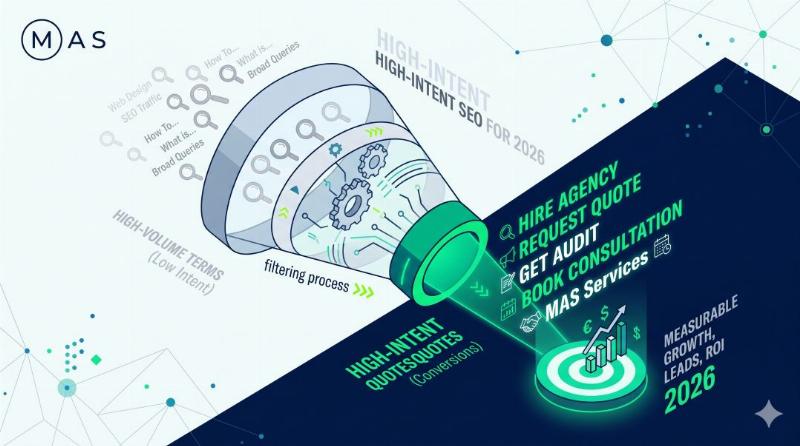

High-Intent SEO Keywords for 2026: Why “Buy” and “Hire” Queries Beat High-Volume Terms for Web Design, PPC, and SEO ROI
Most digital marketing and web development teams still make the same expensive mistake: they begin keyword research with raw search volume, then try to work backward toward business value.
That approach was inefficient five years ago. In 2026, relying solely on high search volume is a massive liability for your organic growth.
Search engine algorithms have fundamentally evolved. Google’s AI Overviews and Search Generative Experience (SGE) now answer broad informational queries directly at the top of the search engine results page (SERP). Modern buyers use Gemini, ChatGPT, and Claude to summarize definitions, compare software platforms, and narrow down service providers long before they click a website link.
The old model of publishing broad, top-of-funnel content and expecting a pipeline of qualified leads is broken.
What still generates predictable revenue is search intent.
When a prospective client searches for “hire SEO expert,” “web design agency pricing,” “PPC campaign manager,” “Google Tag Manager implementation,” or “custom WordPress developer,” they are significantly closer to a transaction than someone searching for a broad head term like "what is digital marketing." Volume by itself is a poor proxy for commercial opportunity.
If your focus is on driving qualified leads, booking discovery calls, and closing revenue, the most lucrative SEO opportunities in 2026 come from lower-volume, long-tail, higher-intent searches that map directly to a buying moment.
The core principle of modern semantic SEO is simple: A keyword is not valuable just because 10,000 people search it. A keyword is valuable because the right person searches it at the exact moment they need a digital solution.
When the goal is profitable growth, audience quality matters far more than raw traffic.
Search volume is not the same thing as demand quality
Search volume indicates how often a phrase is typed into a search bar. It does not tell you whether the searcher is ready to spend money. It does not reveal whether the SERP is dominated by AI summaries, giant software directories, or your direct agency competitors. And it definitely does not guarantee that the visitor will convert into a paying client.
A broad keyword with 15,000 monthly searches (like "web development") can produce terrible business results if:
-
The search intent is informational (students looking for coding tutorials).
-
The query attracts casual researchers instead of B2B buyers.
-
The landing page intent is mismatched.
-
The user is months away from actually hiring a web development agency.
By contrast, a long-tail keyword with 50 monthly searches (like "hire WordPress developer for eCommerce site" or "Meta Ads tracking specialist") can vastly outperform it commercially if:
-
The searcher knows exactly what tech stack or platform they need.
-
The query implies an approved marketing budget.
-
The search maps directly to a specific, optimized service page.
-
The next logical step is requesting a project quote or booking a consultation.
Serious digital strategy in 2026 must be built around conversion probability and entity-based SEO, not vanity metrics.
Keyword value = relevant traffic × conversion intent × margin potential × page fit
What high-intent search queries actually are
High-intent SEO keywords are search queries that signal a strong likelihood of immediate commercial action. That action may be requesting a technical SEO site audit, booking a digital strategy consultation, hiring a developer, or inquiring about PPC campaign management.
Here is a practical breakdown of intent mapping:
| Intent Type | What the Searcher Wants | Example Query | Business Value |
| Informational | Learn a concept | how does facebook pixel work | Low immediate value, useful for brand awareness |
| Commercial Investigation | Compare options | best web design agency for startups | Medium to high value |
| Transactional | Take action now | hire SEO and PPC specialist | Very high value |
| Navigational | Reach a known brand | Make Anything Simple agency | High value if they know your brand |
Why action-driven modifiers are powerful intent markers
In semantic SEO, modifiers matter. “Best” or "Top" can bring research-mode traffic. “Guide” heavily indicates learning intent.
But transaction-focused modifiers compress uncertainty. When a searcher types “hire digital marketing specialist,” they are not asking for a definition of marketing. They are actively looking for a provider to solve a problem.
These high-intent terms accomplish three critical things at once:
-
They clarify the user’s buyer journey stage: The searcher is making progress toward a final decision.
-
They dictate the exact page architecture you must build: "Hire" keywords require a service, consultant, agency, or industry-specific landing page optimized for conversions.
-
They clarify the commercial outcome: The query explicitly points toward a transaction or a booked call.
Why high-intent queries beat high-volume keywords in 2026
1. They attract clients who are closer to the money
High-volume keywords live in the awareness stage, attracting a massive, mixed audience. High-intent keywords act as a filter. If someone searches "SEO," the intent is ambiguous. If someone searches "enterprise technical SEO audit services," the ambiguity collapses. The pool is smaller, but the relevance—and the likelihood of closing a high-ticket contract—is incredibly high.
2. They are easier to map to landing pages that convert
A broad keyword forces you to write a broad article, which inevitably under-converts because it tries to serve too many user intents. High-intent keywords naturally map to landing pages featuring clear service details, tracking integrations, proof of ROI, case studies, and targeted calls to action.
3. They survive the AI search era
AI systems and Large Language Models (LLMs) are excellent at summarizing general knowledge. They cannot replace the need for a business owner to evaluate an agency's portfolio, review their Ahrefs Site Audit process, understand their Google Tag Manager implementation strategies, or read a real-world case study. The closer a query is to action, the harder it is for an AI summary to finish the task alone.
4. They produce superior SEO unit economics
Content production, website health audits, and technical optimization cost time and money. The right question for an agency or business is not, “How much traffic will this keyword bring?” The question is, “What is the likely revenue per visit if we rank #1?”
Where high-volume keywords still fit into your digital strategy
Broad terms still have a strategic place in a holistic SEO ecosystem. They are necessary for:
-
Brand awareness and top-of-funnel category education.
-
Building topical authority and entity relevance in Google's Knowledge Graph.
-
Providing internal linking support to your high-intent service pages.
-
Capturing audiences for Meta Ads retargeting campaigns via tracking pixels.
A durable, future-proof model uses high-volume content to build reach, mid-intent content to shape the buyer's evaluation, and high-intent content to capture the demand the exact moment they are ready to sign a contract.
The highest-value high-intent modifiers for agencies in 2026
Here is how different modifiers signal commercial readiness in the digital services, SEO, and web development space:
| Modifier | What it Signals | Example Keyword Target |
| hire | provider selection | hire WordPress web developer |
| agency | vendor evaluation | full-stack digital marketing agency |
| services | active search | custom web design services |
| specialist | expert-led help | SEO and PPC specialist |
| implementation | technical readiness | Google Tag Manager implementation expert |
| pricing / cost | budget qualification | eCommerce website redesign cost |
| audit | request readiness | technical SEO site health audit |
| near me | local action | web development agency near me |
How to find high-intent keywords that actually convert
1. Start with your exact service offerings
List every specific service, technology stack, and tracking tool you utilize. Then layer on intent modifiers to generate highly targeted long-tail keywords.
-
Instead of "web design" ➔ target "custom WordPress web design agency"
-
Instead of "Facebook ads" ➔ target "Meta Ads Manager campaign specialist"
-
Instead of "SEO" ➔ target "technical SEO and site health audit services"
2. Mine language from client onboarding and discovery calls
Clients do not speak like keyword research tools; they speak in pain points and implementation needs. Look for conversational phrases that signal buying intent:
-
"Can you fix our Facebook Pixel tracking?"
-
"We need a complete website redesign."
-
"Who can manage our PPC and organic search concurrently?"
3. Dig into Google Search Console (GSC)
Look for bottom-of-funnel queries where you are already earning impressions but perhaps lack a dedicated, optimized landing page. If an educational blog post is accidentally ranking for a commercial keyword, that is a massive signal to build a dedicated service page for that specific intent.
4. Build entity-based topical clusters
In 2026, topical authority is paramount. Don't just target one phrase; build an architecture around a core entity:
-
Core Entity: Technical SEO specialist
-
Supporting Cluster: Ahrefs site audit services
-
Supporting Cluster: Google Search Console error fixing
-
Supporting Cluster: Technical SEO campaign management
The pages that win high-intent search in 2026
If the user query says “hire,” do not send the user to a generic 2,000-word blog post. The landing page has to match the moment.
-
Service Landing Pages: Built for “agency,” “consultant,” and “developer” queries. Detail your tech stack, your process, your outcomes, and include a clear, prominent CTA to book a call.
-
Audit & Assessment Pages: Built for buyers wanting validation before a massive commitment (e.g., "Free Technical SEO Health Audit").
-
Industry-Specific Pages: Combine commercial intent with niche specificity (e.g., "Web development for eCommerce" or "Lead generation for B2B").
-
Pricing & Process Pages: Built for “cost” and “packages” queries. Providing transparency filters out unqualified leads and builds immediate trust.
How to write high-intent content that works in Google and LLM-driven discovery
To satisfy both Google's helpful content systems and AI Overviews, your content must be structured, authoritative, and direct.
-
Provide the problem-solution frame instantly: Tell the user exactly what the service is, what tech you use, and what measurable outcome it drives (e.g., higher ROAS, faster load times, improved Core Web Vitals) in the first 100 words.
-
Demonstrate E-E-A-T (Experience, Expertise, Authoritativeness, Trustworthiness): High-intent searchers are evaluating risk. Show them verifiable proof: traffic growth graphs, successful Meta Ads ROAS case studies, and before-and-after site speed metrics.
-
Maintain semantic precision: Keyword stuffing is dead. Instead of repeating the same phrase, naturally weave in related LSI keywords and entities. If you are a digital marketing specialist, naturally mention PPC, organic search engine optimization, Tag Manager, conversion tracking, and structured data.
-
Make the next step frictionless: Use direct, action-oriented CTAs like "Request a Custom Project Quote" or "Book a Digital Strategy Call."
Common mistakes brands make with high-intent keyword strategy
-
Chasing traffic instead of pipeline: A beautiful Google Analytics dashboard means absolutely nothing if the agency calendar has no booked client calls.
-
Vague positioning: Using generic copy instead of highlighting specific, technical expertise (like advanced tracking implementations or specific CMS platform mastery).
-
Ignoring SERP intent: If Google is exclusively ranking service pages for a specific query, writing a 3,000-word informational blog post won't outrank them. Give the search engine the exact page type it is demanding.
A practical digital growth model for 2026
The agencies and brands that win in 2026 are those who understand that a website is not a digital brochure; it is a 24/7 sales enablement tool. It helps the right client choose your agency faster and with more confidence.
Broad visibility matters, but revenue comes from specificity. Rebalancing your content strategy around commercial intent, tracking precision, entity-based SEO, and conversion value is the fastest way to turn your website into your highest-performing salesperson.
FAQ: High-Intent Search for 2026
What is a high-intent keyword in SEO?
A search query that suggests the user is ready to take an immediate commercial action, such as hiring an agency, booking a technical audit, or requesting a quote for a specific digital service.
Why do low-volume, long-tail keywords often convert better?
They completely remove ambiguity. "Digital marketing" is too broad. "Hire Google Tag Manager tracking specialist" is a highly specific query from a user who knows exactly what problem they need solved right now.
Should I stop targeting informational keywords entirely?
No. Informational content builds topical authority, satisfies Google's E-E-A-T requirements, and feeds your retargeting pixels. However, it must be strategically paired with deep, high-converting service pages to capture the demand once the user is educated.
How can I make my site friendly to AI Overviews and Semantic Search?
Use clear H2/H3 heading structures, factual answers, consistent service descriptions, detailed FAQs, and Schema markup. Clearly define your tech stack and expertise so AI models understand exactly what you do, who you serve, and why you are the authority.