

 Bonani DOSH, Dhaka - 1230, Bangladesh
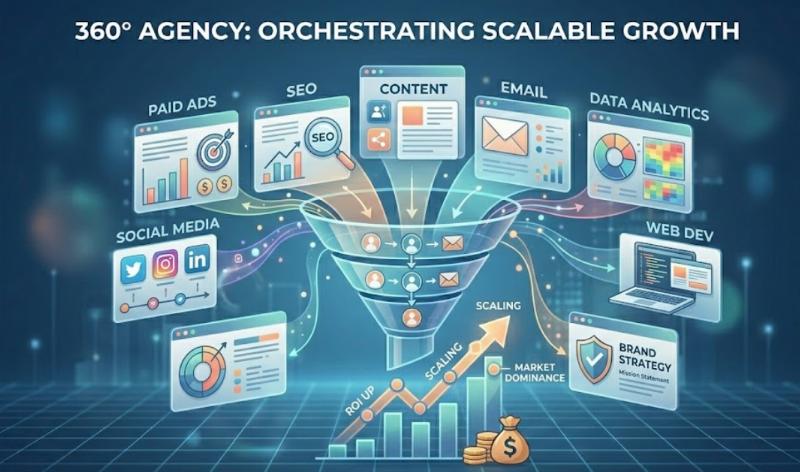

How to Scale a Marketing Agency: A Practical Operating Model
Scaling a marketing agency means increasing the amount of client work the business can deliver without allowing quality, communication or cash flow to become unpredictable. It is not simply adding more service lines or hiring ahead of demand. This guide is an operating framework for agency owners; it makes no claim of a particular agency result or valuation.
1. Define a repeatable offer
Choose a clear customer problem, a client profile the team can serve well and a scope that can be delivered consistently. Document deliverables, review cycles, client responsibilities, exclusions, response times and change requests. A narrow, well-understood offer is often easier to quality-check than a menu that promises every marketing discipline.
2. Build the delivery system before adding volume
- Map the work from onboarding through approval, launch, reporting and renewal.
- Use checklists for recurring tasks, but keep a named owner for decisions and quality review.
- Record assumptions, account access and client approvals in a shared, controlled workspace.
- Set escalation rules for missed deadlines, platform outages, policy rejections and scope changes.
- Review a sample of deliverables before they reach the client; process documents do not replace expert judgment.
3. Manage capacity and unit economics
Track actual delivery hours, external costs, revision load, support time and collected revenue by client or service. A basic contribution view is collected client revenue minus direct delivery labor and variable production costs. It is not the same as net profit: overhead, taxes, sales costs and unpaid invoices still matter.
Monitor a small set of operating signals together: qualified pipeline, signed work, onboarding time, team utilization, delivery margin, renewal/churn, overdue receivables and client concentration. Define each metric consistently. There is no universal “healthy” target; compare against your own history and capacity.
4. Hire or partner to solve a demonstrated bottleneck
Identify work that repeatedly delays delivery or requires a skill the current team lacks. Decide whether the role should be an employee, specialist partner or time-limited contractor based on workload, confidentiality, continuity and cost. Document access permissions, review responsibilities and backup coverage before delegating client accounts.
5. Protect client trust as the team grows
- Keep account ownership and admin access clear; use least-privilege permissions and secure handovers.
- Separate reporting facts from interpretations and recommendations.
- Do not guarantee platform outcomes or use client results without permission and context.
- Make cancellation, data return, account transfer and open-work handling explicit.
Clients evaluating an agency should also review service scope and ownership. See this related guide on choosing a full-service digital marketing agency.
A measured path to growth
- Find the current constraint: sales, onboarding, delivery, review capacity or cash collection.
- Test one operational change on a bounded set of work.
- Compare quality, timing and contribution with a defined baseline.
- Keep the change only if it improves the system without shifting hidden costs onto staff or clients.
- Expand capacity in line with signed demand and a realistic cash buffer.
Bottom line: Durable agency growth is an operations problem as much as a sales problem. Standardize what repeats, preserve expert review, understand the full cost of delivery and add capacity only when the evidence supports it.
2026 Implementation Roadmap: Building a Scalable 360-Degree Marketing & Attribution System
Turning strategy into measurable business growth requires a disciplined execution workflow. Across client engagements at Make Anything Simple, teams that outperform their competitors consistently focus on three pillars: clean technical foundations, first-party conversion measurement, and iterative creative or content testing. Rather than launching isolated tactics, use the phased roadmap below to align every campaign and page update with revenue outcomes.
Phase 1: Baseline Audit & Technical Readiness (Weeks 1?2)
- Search & UX Diagnostics: Audit existing landing pages for crawlability, indexation hygiene, mobile responsiveness, and Core Web Vitals (LCP under 2.5s, INP under 200ms, CLS below 0.1).
- Signal Integrity & Attribution: Verify that every primary conversion action?lead form submissions, WhatsApp/Messenger inquiries, checkout steps, and phone clicks?fires with deduplicated browser and server event IDs via Marketing Attribution & Reporting.
- Offer & Intent Alignment: Map each target keyword or audience segment to a dedicated page with a single primary call-to-action rather than sending paid or organic traffic to generic catch-all pages.
Phase 2: Structured Execution & Creative Testing (Weeks 3?6)
Once tracking and landing page fundamentals are verified, shift focus to controlled production velocity. Document every hypothesis before publishing new assets:
- Define the Primary KPI: Separate leading indicators (scroll depth, hook hold rate, qualified click-through rate) from lagging business metrics (cost per qualified lead, customer acquisition cost, and net ROAS).
- Build Modular Assets: Structure page sections and ad creatives modularly?headline hook, proof block, objection handler, and risk-reversal CTA?so individual elements can be swapped without rebuilding from scratch.
- Internal Linking & Funnel Continuity: Connect informational guides directly to commercial solution pages such as 360? Digital Growth Services and transparent package comparisons on Growth & Retainer Packages so high-intent visitors can act immediately.
Key Performance Indicators (KPIs) to Monitor Monthly
Avoid vanity metrics that mask inefficient spend or low-intent traffic. Review the following scorecard during weekly and monthly growth reviews:
- Qualified Conversion Rate (CVR): Percentage of sessions that result in a verified sales inquiry, booking, or completed checkout.
- Event Match & Attribution Quality: Consistency between ad platform reported conversions, GA4 key events, and actual CRM or backend orders.
- Content & Landing Page Indexation Ratio: Share of published URLs that earn active impressions and clicks in Google Search Console without canonical conflicts or thin-content flags.
- Payback Period & LTV:CAC Ratio: Time required for gross margin from acquired customers to recover initial marketing and production investment.
Common Pitfalls That Stall Growth (And How to Fix Them)
When campaigns or organic pages plateau, the root cause is rarely a single algorithm change. In most audits, performance drops trace back to one of four operational gaps:
- Fragmented Tracking: Running paid campaigns or publishing content without server-side event validation leads to blind budget allocation. Pair your funnel with Tracking & Analytics Services to keep data reliable.
- Slow or Cluttered Landing Experiences: Heavy scripts, unoptimized images, and unclear pricing create friction on mobile networks. Explore our Web Design Services to build fast, conversion-focused layouts.
- Inconsistent Follow-Up Speed: Leads contacted within five minutes convert at significantly higher rates than leads contacted hours later. Automate instant confirmation and routing across web, WhatsApp, and Messenger.
- Unstructured Scope & Budgeting: Scaling without clear deliverables creates bottlenecks. Review standardized deliverables and turnaround times on our Growth & Retainer Packages page before kicking off your next sprint.
Frequently Asked Questions
How long does it take to see measurable results from Building a Scalable 360-Degree Marketing & Attribution System?
Technical fixes, tracking repairs, and landing page conversion improvements typically show measurable lift within 14 to 30 days. Compounding organic search authority and multi-channel customer acquisition pipelines generally mature over a 60-to-90-day testing cycle.
Should we prioritize traffic volume or conversion rate optimization first?
Always fix conversion readiness and measurement accuracy first. Doubling conversion efficiency from 1.5% to 3.0% immediately halves your effective acquisition cost across every future traffic source?organic, paid, and referral.
How can Make Anything Simple help implement this workflow?
Our team handles end-to-end strategy, technical implementation, creative production, and ongoing optimization. You can explore our 360? Digital Growth Services, compare transparent packages on Growth & Retainer Packages, or contact our team for a tailored audit and implementation roadmap.