

 Bonani DOSH, Dhaka - 1230, Bangladesh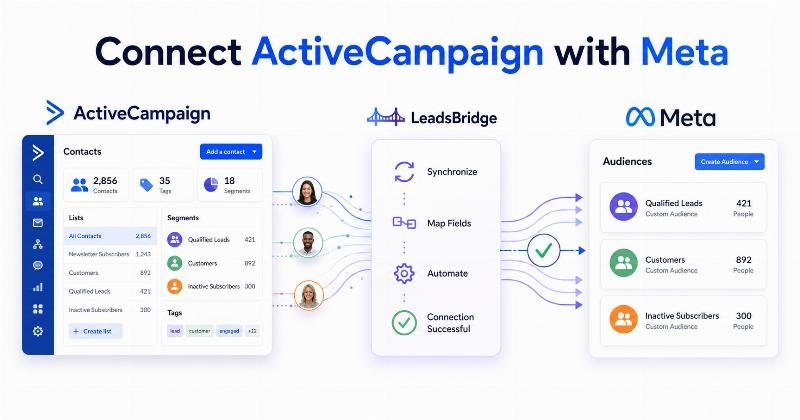

ActiveCampaign Audience Targeting by LeadsBridge: Connect Contacts to Meta Custom Audiences
ActiveCampaign can hold a large amount of useful marketing information: subscribed contacts, customer tags, lead scores, product interests, form activity, email engagement and lifecycle stages. The difficulty begins when a marketing team wants to use those groups in Meta advertising. Exporting contacts to a spreadsheet, correcting the file and repeatedly uploading it to Meta Ads Manager can become slow and unreliable as contacts enter or leave each segment.
ActiveCampaign Audience Targeting by LeadsBridge connects selected ActiveCampaign lists, tags or segments with Meta Customer List Custom Audiences so that audience updates can be managed through an automated bridge instead of repeated manual uploads.
ActiveCampaign acts as the source of contact and segmentation data. LeadsBridge provides the third-party connection and synchronization workflow. Meta processes the submitted customer identifiers and builds the destination Custom Audience that may be used in Facebook and Instagram campaigns.
This guide explains what the integration does, how the platforms work together, what data may be mapped, how to configure a bridge, what free and paid options currently exist, and how to manage privacy, exclusions, testing and troubleshooting. It also explains an important alternative: ActiveCampaign currently provides its own native Facebook Custom Audiences integration, so LeadsBridge is not necessarily the only method available.
What Is ActiveCampaign Audience Targeting by LeadsBridge?
ActiveCampaign Audience Targeting by LeadsBridge is a third-party integration workflow designed to synchronize selected ActiveCampaign contacts with a Meta Customer List Custom Audience.
LeadsBridge’s official integration directory currently describes three main ActiveCampaign sources that can be used for this purpose:
- Contacts selected from an ActiveCampaign list
- Contacts associated with an ActiveCampaign tag
- Contacts belonging to an ActiveCampaign segment
The marketer connects ActiveCampaign to LeadsBridge, authorizes the appropriate Meta advertising account, selects or creates the destination audience, maps supported customer identifiers and chooses the available synchronization settings.
The integration is primarily designed for businesses that already organize leads and customers inside ActiveCampaign and want to reuse those classifications in Meta advertising. Relevant users include B2B marketing teams, ecommerce businesses, agencies, membership companies, software businesses, service providers and organizations running continuous Facebook or Instagram campaigns.
It can reduce repeated CSV exports and help keep advertising audiences closer to the current state of the ActiveCampaign database. It does not replace ActiveCampaign’s email marketing and automation functions, and it does not replace Meta Ads Manager, where campaigns, budgets, placements and advertisements are managed.
It also does not guarantee that Meta will match every contact, deliver ads to every matched person or improve advertising performance.
About ActiveCampaign, LeadsBridge and Meta
What Is ActiveCampaign?
ActiveCampaign is a marketing automation and customer-experience platform. Businesses use it to store contacts, send email campaigns, create automated journeys, record form submissions, apply tags, manage lists, maintain custom fields and organize contacts into segments.
ActiveCampaign contacts can be classified using several connected tools:
- Lists represent broad subscription or communication groups.
- Tags provide flexible labels for interests, actions, sources or lifecycle stages.
- Custom fields hold structured information such as location, product interest or customer type.
- Segments identify contacts who meet selected conditions.
- Contact and deal scores may help teams identify engagement or sales readiness.
- Automations add, remove or update contacts when particular events occur.
ActiveCampaign’s current documentation describes saved segments as dynamic groups. Contacts can enter or leave them when they begin or stop meeting the conditions. That characteristic makes segments useful for advertising synchronization because the source group can change without rebuilding it manually.
What Is LeadsBridge?
LeadsBridge is a third-party integration platform focused on connecting advertising systems with CRMs, email platforms, databases, forms and other marketing tools.
A connection created inside LeadsBridge is commonly called a bridge. Every bridge has a source and a destination. For this workflow:
- ActiveCampaign is the source.
- Meta or Facebook Custom Audiences is the destination.
- LeadsBridge manages the configured data movement between them.
LeadsBridge supports several types of marketing workflows, including lead synchronization, advertising-audience synchronization and conversion-data transfer. Those functions should not be confused with one another. Sending a Facebook Lead Ads submission into ActiveCampaign is different from sending an existing ActiveCampaign segment into a Meta Custom Audience.
What Are Meta Custom Audiences?
A Meta Custom Audience allows an advertiser to create an audience from an existing business relationship or interaction. Meta supports several audience-source categories, subject to current account and regional availability.
Common types include:
- Customer-list Custom Audiences
- Website-activity audiences based on Meta Pixel data
- App-activity audiences
- Engagement audiences based on Meta-platform interactions
- Applicable offline-activity audiences
The ActiveCampaign and LeadsBridge workflow discussed in this article primarily concerns a Customer List Custom Audience. The business submits supported identifiers, and Meta attempts to match them with accounts on its technologies.
The original ActiveCampaign contact count and the final Meta audience size will not necessarily be equal. Some people may use a different email address or phone number for Meta, and some source records may be incomplete, duplicated, outdated or incorrectly formatted.
Roles of the Three Platforms
| Platform | Primary Role | What It Does Not Control |
|---|---|---|
| ActiveCampaign | Stores contacts and organizes them through lists, tags, fields, scores and segments | Meta’s final customer matching and advertising delivery |
| LeadsBridge | Transfers and synchronizes configured source data with the destination audience | Campaign creative, budget, bidding or guaranteed marketing results |
| Meta | Processes identifiers, builds the matched audience and uses it within eligible campaigns | The accuracy and lawful collection of the advertiser’s source database |
Is LeadsBridge the Only Way to Connect ActiveCampaign with Meta?
No. This is an important consideration before paying for another platform.
ActiveCampaign currently documents a native Facebook Custom Audiences integration. It can connect a Facebook Ads account to ActiveCampaign and provide automation actions for adding or removing contacts from a Customer List Custom Audience.
The native integration currently provides actions such as:
- Add to Facebook Custom Audience
- Remove from Facebook Custom Audience
Only contacts that pass through the relevant ActiveCampaign automation actions are added or removed through that native workflow. ActiveCampaign also documents segment conditions for identifying contacts who were added to or removed from an audience through those actions.
LeadsBridge remains a valid alternative when a business prefers a separate audience-management layer, wants synchronization from lists, tags or saved segments, manages several advertising and CRM connections, or needs centralized integration monitoring.
Before choosing a method, compare:
- The ActiveCampaign plan required for its native advertising integration
- The LeadsBridge plan required for Facebook Audiences
- The desired source structure: automation actions, tags, lists or segments
- Required monitoring and error-reporting tools
- The number of audiences and advertising accounts
- Internal security and vendor-review requirements
Availability, features or requirements may vary. Check the current official documentation before implementation.
How the ActiveCampaign and Meta Integration Works
ActiveCampaign list, tag or segment → LeadsBridge bridge → Meta Customer List Custom Audience → Facebook or Instagram campaign
1. ActiveCampaign Provides the Source Group
The marketer identifies the contacts that should enter the destination audience. The group may be associated with a list, tag or saved segment supported by the connector.
Examples include:
- Contacts tagged as demo requested
- Contacts subscribed to a customer newsletter
- Marketing-qualified leads above a score threshold
- Current customers who should be excluded from acquisition advertising
- Inactive subscribers who remain eligible for re-engagement
2. LeadsBridge Authenticates ActiveCampaign
LeadsBridge’s current ActiveCampaign documentation instructs users to authorize the account using an ActiveCampaign API URL and API key. ActiveCampaign provides these credentials from the account’s Developer settings.
API credentials should be treated like sensitive login information. ActiveCampaign notes that API credentials belong to individual users. Removing the user whose credentials support an integration can break that connection.
3. The Meta Destination Is Authorized
The user connects the relevant Meta account and grants the requested permissions. The correct Business Portfolio and advertising account must be selected, especially when an agency manages several clients.
4. The Destination Audience Is Selected
Depending on the current interface, the user may select an existing Customer List Custom Audience or create a new destination audience.
A descriptive name should identify the source, segment, region and purpose. For example:
ActiveCampaign-MQL-UK-Retargeting
5. Customer Fields Are Mapped
Source fields are matched with destination identifiers. Required fields should be completed, while unnecessary information should remain unmapped.
LeadsBridge also documents transformation functions that may help normalize dates, text or phone-number formats. Available functions and fields should be confirmed in the current bridge builder.
6. Filters May Be Added
A filter can restrict which source contacts continue through the bridge. For example, a marketer might include only records that have a valid email address, remain subscribed and are not tagged as employees.
7. A Synchronization Schedule Is Configured
LeadsBridge’s current Custom Audience documentation describes selectable synchronization intervals. Its ActiveCampaign documentation also recommends allowing sufficient time for the ActiveCampaign API to process larger contact groups.
Official ActiveCampaign connector guidance specifically warns that an aggressive six-hour schedule may cause an audience to remain in a recurring synchronization loop in some situations. It suggests considering 24- or 48-hour synchronization for ActiveCampaign audiences.
This is guidance rather than a universal requirement. The best interval depends on list size, source performance, campaign urgency and currently available account settings.
8. The Workflow Is Tested
LeadsBridge provides a simulation function for reviewing source processing before live data is sent. A published bridge left in simulation mode does not create or update the live destination audience.
9. Meta Processes the Audience
After records are transferred, Meta performs its matching process. Updates are not necessarily immediate. Meta states that customer-list audience changes may require several hours to finish processing.
10. The Integration Is Monitored
The marketer should monitor both LeadsBridge and Meta. Relevant checks include the last execution time, records processed, additions, removals, errors, destination status and expired authorizations.
What Data Can Be Used?
LeadsBridge’s general Facebook Custom Audiences documentation identifies several possible matching fields. Exact availability depends on the ActiveCampaign source data, LeadsBridge connector version, Meta requirements and account configuration.
| Possible Data | Typical Purpose | Important Consideration |
|---|---|---|
| Email address | Primary contact identifier | Remove spaces, invalid addresses and obvious typing errors |
| Phone number | Additional matching identifier | Use a consistent international format |
| First name | Supplementary identifier | Keep it separate from the last-name field |
| Last name | Supplementary identifier | Avoid placing an entire name in the wrong field |
| Country | Geographical matching context | Use consistent country names or codes |
| City | Additional location context | Correct spelling and formatting matter |
| State or region | Additional location context | Use consistent regional values |
| Postal code | Additional matching information | Preserve valid leading zeros |
| Date of birth | Potential matching identifier | Use only when justified, lawfully collected and supported |
| Gender | Potential matching identifier | Do not assume or unnecessarily collect it |
| Customer value | Potential value-based audience workflow | Verify current support before relying on it |
Segmentation Information vs Matching Information
Not every ActiveCampaign field needs to be sent to Meta. A tag such as Requested Demo may determine who belongs in the source segment, while email address and phone number are the fields used for matching.
The business can use internal information such as the following to define a segment:
- Lead source
- Lifecycle stage
- Subscription status
- Product interest
- Form submission
- Email engagement
- Contact score
- Deal status
- Customer status
- Event registration
- Last purchase date
- Geographical market
Those internal attributes should not automatically be transferred as customer identifiers. Map only the information required by the destination and permitted for the intended purpose.
Why Data Quality Matters
Poor source data can create technical failures and reduce potential matching. Before synchronization:
- Remove duplicate contacts where appropriate.
- Normalize email and phone fields.
- Separate active contacts from unsubscribed or suppressed records.
- Remove internal tests and employee records.
- Check that segment conditions produce the intended contacts.
- Avoid transferring unnecessary personal information.
Main Benefits of ActiveCampaign Audience Targeting by LeadsBridge
Reduced Manual CSV Work
Without an integration, the marketing team must export contacts, edit the file, upload it to Meta, map the identifiers and repeat the process whenever the audience changes.
A configured bridge can reduce that repetitive work. This matters when several segments must be updated regularly. It does not eliminate the need to monitor the source data or integration status.
More Current Advertising Audiences
Dynamic ActiveCampaign segments can change as contact behavior or attributes change. Scheduled synchronization can make the Meta audience more representative of the current source group than an old spreadsheet upload.
For example, a contact who becomes a customer can move from a prospect segment into a customer-exclusion segment. The update timing depends on the source, bridge schedule and Meta processing.
Improved Audience Segmentation
Instead of sending one large contact database to Meta, marketers can build purpose-specific audiences such as qualified leads, recent customers, inactive subscribers or webinar registrants.
More detailed segmentation supports more relevant campaign planning, but it does not guarantee better delivery or conversion performance.
Better Customer Exclusions
A current customer segment can be used as an exclusion from a new-customer campaign. This may reduce situations in which existing customers repeatedly receive an introductory offer intended for first-time buyers.
Campaign teams should verify that the Custom Audience has been configured as an actual exclusion rather than only an audience suggestion under Meta’s current campaign controls.
Cross-Channel Coordination
ActiveCampaign may deliver email nurture content while Meta displays complementary advertising to the same lifecycle group.
For example, contacts in a product-comparison email sequence might receive a customer-story advertisement instead of an unrelated awareness message.
Less Repetitive Field Mapping
Once mappings are correctly configured, the same bridge can reuse them. This reduces repeated spreadsheet formatting but does not repair incorrect source values automatically in every case.
Centralized Synchronization Monitoring
LeadsBridge provides audience-management information such as synchronization history, last execution, processed contacts and errors. This gives the team an integration-level view in addition to the audience status inside Meta.
Scalable Audience Management
A business managing multiple regions, products or client accounts may find a standardized bridge structure easier to scale than separate manual-upload routines.
Scaling also increases subscription requirements, governance needs and the risk of duplicate or overlapping audiences.
Practical Use Cases
1. Retargeting High-Intent Leads
Source information: ActiveCampaign contacts who submitted a demo form, visited an important page or reached a defined lead score.
Destination: A Meta Custom Audience for high-intent prospects.
Business action: Display customer proof, implementation information or a consultation invitation.
Intended result: Maintain communication with qualified prospects across email and paid social.
Limitation: A lead score does not always represent immediate buying intent, and Meta may not match every contact.
2. Marketing-Qualified Lead Campaigns
Source information: Contacts classified as MQLs through tags, fields or segment conditions.
Destination: A focused MQL audience.
Business action: Show decision-stage resources or industry-specific proof.
Intended result: Align paid advertising with ActiveCampaign’s lifecycle classification.
Limitation: Existing customers and active sales opportunities may need separate exclusions.
3. Existing-Customer Exclusion
Source information: Contacts tagged as customers or included in a current-customer segment.
Destination: A Meta exclusion audience.
Business action: Exclude those contacts from campaigns intended exclusively for new customers.
Intended result: Create a more organized distinction between acquisition and customer marketing.
Limitation: Delayed source updates can temporarily leave recent customers in prospecting campaigns.
4. Upselling Existing Customers
Source information: Customers using an entry-level product or service.
Destination: A customer-upgrade audience.
Business action: Promote relevant education about an advanced plan or related service.
Intended result: Coordinate expansion marketing across email and Meta.
Limitation: Customers who already upgraded must be excluded promptly.
5. Inactive-Lead Re-engagement
Source information: Contacts who previously engaged but have not opened, clicked or responded within a selected period.
Destination: A re-engagement audience.
Business action: Present updated educational content, a new event or a relevant resource.
Intended result: Test whether a different channel can re-establish contact.
Limitation: Older information may match poorly, and inactive records still require an appropriate basis for advertising use.
6. Webinar or Event Follow-Up
Source information: Event registrants, attendees or no-shows identified through tags or fields.
Destination: Separate Meta audiences for each attendance status.
Business action: Promote the recording to no-shows and the next step to attendees.
Intended result: Deliver more relevant post-event communication.
Limitation: Attendance data must be updated before the audience is synchronized.
7. Regional Advertising
Source information: Eligible contacts grouped by country, city or service area.
Destination: Region-specific Custom Audiences.
Business action: Display a local event, office or language-specific message.
Intended result: Coordinate contact information with regional campaign planning.
Limitation: Incomplete or outdated location data can place contacts in the wrong group.
8. Account-Based Marketing Support
Source information: Contacts from selected target accounts or industries.
Destination: An account-based audience where permitted and sufficiently populated.
Business action: Show sector-specific content or customer evidence.
Intended result: Support coordinated outreach to priority accounts.
Limitation: A narrow source group may be too small for practical Meta delivery.
Requirements Before Setup
- An active ActiveCampaign account: The source contacts, lists, tags and segments must be accessible.
- ActiveCampaign API access: LeadsBridge currently uses the account’s API URL and key for authorization.
- A suitable integration user: Removing that user or resetting the key can interrupt the connection.
- A LeadsBridge account: The bridge and its synchronization settings are managed there.
- An eligible LeadsBridge plan or trial: The live pricing page currently lists Facebook Audiences as a Pro feature.
- A Meta Business Portfolio: It organizes the relevant advertising assets and user access.
- A Meta advertising account: The Customer List Custom Audience belongs to an ad account.
- Audience-management permission: The connected user must be allowed to create or update the audience.
- Accepted Meta terms: Customer List Custom Audiences are subject to specific Meta terms.
- Lawfully collected first-party data: The business must have the rights and appropriate basis to use it.
- Clean contact identifiers: Incorrect values can cause failures or reduce matching.
- A defined source segment: Avoid synchronizing an uncontrolled master database.
- A naming convention: Clear names reduce incorrect audience selection.
- A testing plan: Test mappings, filters, removals and account selection before launch.
Step-by-Step Setup Guide
Step 1: Define the Audience Purpose
Decide whether the destination audience is intended for retargeting, customer marketing, exclusion, re-engagement or another clearly defined purpose.
Avoid beginning with a general group such as all contacts unless that group genuinely supports the campaign objective.
Step 2: Prepare the ActiveCampaign Source
Create or review the relevant list, tag or saved segment. Confirm that it contains the intended contacts and excludes invalid, unsubscribed, suppressed or internal records where appropriate.
[Screenshot: Reviewing an ActiveCampaign segment]
Step 3: Obtain the ActiveCampaign API Credentials
Use the current ActiveCampaign account settings to locate the Developer section and obtain the API URL and key. Store these credentials securely and do not place them in public documentation.
Step 4: Sign In to LeadsBridge
Create or access a LeadsBridge account. Confirm that the selected plan or trial allows Facebook Audience synchronization before building a production workflow.
Step 5: Create a New Bridge
Begin a new connection from the current bridge-creation area. Provide a descriptive internal bridge name.
[Screenshot: Creating a new bridge]
Step 6: Select ActiveCampaign as the Source
Choose ActiveCampaign in the source selector. Select an existing authorized connection or create a new one using the API URL and key.
[Screenshot: Selecting ActiveCampaign as the source]
Step 7: Select the Source Type
Select the supported source structure appropriate to the campaign, such as a list, tag or segment. Confirm the preview or expected contact count if that information is available.
Step 8: Select Facebook Custom Audiences as the Destination
Choose the current Facebook or Meta Custom Audiences destination. Follow the authorization process and grant only the permissions necessary to manage the required advertising asset.
[Screenshot: Authorizing the Meta destination]
Step 9: Confirm the Correct Advertising Account
Review the Business Portfolio, ad-account name and numerical account ID. Agencies should verify the client identity carefully before continuing.
Step 10: Select or Create the Destination Audience
Choose the intended existing Customer List Custom Audience or create a new one where the current interface permits it.
Use a naming structure such as:
Source-Segment-Region-Purpose
Example: ActiveCampaign-Customers-BD-Exclusion
Step 11: Map the Contact Fields
Match available ActiveCampaign fields with the supported destination identifiers. Complete required fields and leave unnecessary information unmapped.
[Screenshot: Mapping ActiveCampaign fields]
Step 12: Configure Source Filters
Add filters when the original source group requires further restriction. For example:
- Email is not empty
- Subscription status is active
- Customer status is not employee
- Tag does not equal test record
Step 13: Configure Synchronization Settings
Select an available schedule that reflects the size and urgency of the audience. Consider the current LeadsBridge recommendation to use a less aggressive interval for larger ActiveCampaign sources.
Availability, features or requirements may vary. Check the current official documentation before implementation.
Step 14: Test or Simulate the Bridge
Use the available test or simulation function to review the records, mappings and filter results. Remember that a bridge left in simulation mode does not send live data.
[Screenshot: Testing the audience bridge]
Step 15: Publish the Bridge
After validating the test, disable simulation when live synchronization is intended, save the settings and publish the bridge.
Step 16: Verify the Result in Meta
Open Meta Ads Manager’s audience area and confirm:
- The correct audience name
- The correct advertising account
- The audience status
- Population or processing progress
- The latest update
- Any warning or policy message
[Screenshot: Verifying the Custom Audience in Meta]
Step 17: Apply the Audience Carefully
Select the audience at the appropriate campaign or ad-set level. Confirm whether it is being used as a target, suggestion or exclusion under the current Meta campaign interface.
Free Plan, Free Trial and Paid Plans
Pricing and feature availability were checked on 3 August 2026.
The wording “Free and paid plans available” can be misleading if it is interpreted to mean that permanent audience synchronization is included in the free plan.
LeadsBridge’s live pricing page currently shows:
- A Free self-service plan
- A Pro self-service plan
- A Business managed-service plan
The live page lists Facebook Audiences under the Pro feature set. It also states that a new Pro account can receive a 14-day trial of audience and conversion features.
However, there is a conflict across official LeadsBridge materials. A support article updated in December 2025 describes four plans—Free, Starter, Pro and Business—while the current live pricing page does not display Starter as a primary option. Another official Custom Audience support page states that the benefits of Custom Audience Sync are available across all plans, which does not clearly match the live pricing page’s placement of Facebook Audiences under Pro.
Because the live pricing page and support documentation do not present completely consistent plan information, confirm the feature inside the current LeadsBridge account dashboard or contact LeadsBridge before subscribing.
| Option or Plan | General Purpose | Relevant Feature Availability | Important Limitation |
|---|---|---|---|
| LeadsBridge Free | Limited lead movement between supported platforms | The live pricing page does not currently list Facebook Audiences as an included Free feature | A free signup should not be treated as confirmation of permanent audience synchronization |
| LeadsBridge Pro Trial | Temporary evaluation of advanced audience and conversion tools | Official pricing currently describes a 14-day Pro trial | Trial access is temporary and may require a paid plan afterward |
| LeadsBridge Pro | Self-service audience, conversion and broader integration workflows | The current live page lists Facebook Audiences | Pricing varies by usage selections; verify the live calculator |
| LeadsBridge Business | Managed, customized and enterprise-oriented service | Includes Pro functionality and additional managed capabilities | Designed for larger or specialized requirements |
| LeadsBridge Starter | Referenced in a December 2025 support article as a paid lead-and-conversion tier | Audience Targeting was associated with Pro in that support article | The current live pricing page does not display Starter as a main plan; verify availability |
| ActiveCampaign Trial | Temporary access to evaluate ActiveCampaign | ActiveCampaign currently promotes a 14-day trial | It is not a permanent free ActiveCampaign account |
| ActiveCampaign Paid Plans | Email marketing, automation and related platform capabilities | Current plan documentation lists Starter, Plus, Professional and Enterprise | Verify which plan includes the required native ad-platform feature |
ActiveCampaign is a separate product with separate pricing. Its current public pricing journey emphasizes tailored pricing based on requirements and contact volume. Do not combine the cost of ActiveCampaign with LeadsBridge when calculating the integration budget.
Pricing, plan names and feature limits can change. Review the current official pricing page before subscribing.
Manual Upload vs Automated LeadsBridge Integration
| Factor | Manual Method | Automated Integration |
|---|---|---|
| Initial setup | Relatively simple for one audience | Requires account authorization, mapping and testing |
| Ongoing maintenance | Requires repeated exports and uploads | Runs according to the configured workflow |
| Data freshness | Depends on the last manual upload | Depends on source changes, schedule and destination processing |
| Human error | Higher risk during repeated file handling | Lower after correct setup, but configuration errors remain possible |
| Scalability | Difficult across many segments and accounts | Better suited to recurring, structured workflows |
| Monitoring | Mostly file records and Meta audience history | Bridge history plus Meta audience status |
| Contact removal | Requires a new update or removal file | May be handled through synchronization where supported |
| Field mapping | Repeated during manual uploads | Reusable after bridge configuration |
| Cost | No additional connector subscription | Eligible LeadsBridge plan may be required |
| Best use case | Small, one-time or infrequently changing lists | Frequently changing segments and ongoing campaigns |
Manual uploading remains reasonable when a business has a small database, one occasional campaign or no need for regular audience changes.
Automation becomes more valuable when multiple groups must be updated repeatedly, customer exclusions change frequently or an agency manages several audience workflows.
Privacy, Consent and Data Protection
This integration uses customer or prospect information for advertising-audience matching. The business remains responsible for deciding whether that use is lawful, appropriately disclosed and consistent with the expectations created when the data was collected.
Use Legitimate First-Party Data
Use information collected directly through appropriate business interactions, such as subscriptions, customer relationships, form submissions or account registrations.
Do not assume that a purchased, scraped or third-party contact list is eligible for audience creation.
Maintain a Lawful Basis
Meta’s Customer List Custom Audiences Terms require the advertiser to possess the necessary rights, permissions and lawful basis to disclose and use the customer data.
An agency uploading information for a client must also have authority to act for that advertiser.
Provide Appropriate Notice
The business’s privacy notice should explain applicable marketing, advertising, audience-matching and third-party processing practices in a way that reflects the relevant jurisdiction.
Respect Opt-Outs and Suppression
Meta’s terms require advertisers to avoid using data belonging to people whose relevant opt-out commitment must be honored. If a person opts out after being added, the advertiser is responsible for removing that person from the audience.
ActiveCampaign subscription status, suppression lists and audience-removal processes should therefore be reviewed together.
Apply Data Minimization
Transfer only identifiers needed for the matching purpose. The existence of an available mapping field does not automatically justify using it.
Avoid Sensitive Information
Do not use sensitive health, financial, political, religious or other protected information to create advertising segments without a proper legal and platform-policy assessment. Some uses may be prohibited regardless of consent.
Protect Account Credentials
Restrict access to ActiveCampaign API credentials, LeadsBridge connections and Meta advertising assets. Review user permissions regularly and reset compromised credentials immediately.
Consider Regional Requirements
GDPR, UK GDPR, CCPA, CPRA and other privacy laws can impose different transparency, lawful-basis, data-rights and contractual requirements. The applicable obligations depend on the business, the people involved and the way the data is processed.
The integration does not automatically create legal compliance. Meta approval does not replace legal obligations, and the business remains responsible for its data practices. Professional legal advice may be required for regulated or sensitive use cases.
Best Practices
- Start with one clearly defined audience. Validate a single workflow before creating many similar bridges.
- Use a saved ActiveCampaign segment with a documented purpose. Teams should understand exactly why each contact qualifies.
- Clean the source data first. Correct malformed emails, inconsistent phone numbers and duplicated records before synchronization.
- Respect subscription and suppression status. Do not treat every database contact as advertising-eligible.
- Use descriptive names. Include the source, segment, region and intended use in the bridge and audience names.
- Map only useful identifiers. Additional information should be included only when supported, accurate and justified.
- Test with controlled records. Verify additions, exclusions and removals before processing a large segment.
- Confirm the numerical ad-account ID. This reduces mistakes when several accounts have similar names.
- Use a realistic synchronization schedule. An unnecessarily frequent schedule may create processing problems without improving the campaign.
- Monitor the bridge history. Check the last successful run, failed records and authorization status.
- Document ownership and mappings. Record who manages the bridge, which fields are used and when it should be reviewed.
- Measure marketing results separately. Successful synchronization proves technical operation, not campaign effectiveness.
Common Mistakes to Avoid
Selecting the Wrong Meta Account
This frequently occurs in agencies or multi-brand organizations. It can place customer information in an unintended advertising account. Confirm both the account name and numerical ID.
Using the Wrong ActiveCampaign Source
A similarly named tag or segment may contain a different group. Review the source logic and sample contacts before publishing.
Synchronizing Every Contact
A master database may include customers, prospects, unsubscribed people, employees and test records. Build a purpose-specific audience instead.
Including Unsubscribed or Suppressed Records
Email unsubscribe status and advertising opt-out obligations are not always identical, but both require careful handling. Apply documented eligibility and suppression rules.
Mapping the Wrong Fields
Placing a full name in an email field or a local number in an incorrectly defined phone field can cause failures or poor matching. Inspect the test data.
Using Inconsistent Phone Formats
A single database may contain local, international and text-formatted phone numbers. Normalize the values before transfer.
Leaving Simulation Mode Enabled
The bridge may appear published but send no live data. Disable simulation only after reviewing the test report and when the workflow is ready for production.
Expecting Immediate Audience Availability
Meta may require several hours to process customer-list updates. Review the audience status before diagnosing a failure.
Ignoring Plan Eligibility
A free signup or trial does not necessarily provide permanent Facebook Audience synchronization. Verify the current entitlement before building a production dependency.
Letting API Credentials Expire or Break
Resetting an ActiveCampaign API key or deleting its user can stop the bridge. Update connected applications whenever credentials change.
Creating Duplicate Audiences
Poor naming and undocumented ownership can result in several audiences containing similar people. Use a clear governance system.
Assuming Automation Guarantees Performance
Audience synchronization cannot fix an unsuitable offer, poor creative, weak measurement or inadequate campaign strategy.
Troubleshooting ActiveCampaign and Meta Audience Sync
| Problem | Possible Cause | Recommended Check | Suggested Resolution |
|---|---|---|---|
| ActiveCampaign authentication fails | Incorrect API URL or key | Developer settings and copied credentials | Reconnect using valid credentials |
| Integration stops after a user is removed | The deleted user owned the API credentials | Original integration user | Authorize with credentials belonging to an active user |
| Meta authorization fails | Expired session or missing permission | Business Portfolio and ad-account access | Reconnect the Meta account and approve required permissions |
| Advertising account is missing | Wrong Meta profile or insufficient access | Assigned assets and user role | Grant the correct access or use the proper profile |
| Custom Audience is missing | Wrong account, ownership or audience type | Audience owner and destination account | Select or create an eligible Customer List Custom Audience |
| No contacts synchronize | Empty source, restrictive filter or simulation mode | Source count, filter preview and simulation setting | Correct the source or filter and run another test |
| Required field error | A mandatory destination field is unmapped | Fields marked as required | Map an appropriate source value |
| Invalid email errors | Malformed or blank addresses | ActiveCampaign email field | Clean invalid records before retrying |
| Invalid phone errors | Inconsistent number formatting | Country code and unwanted characters | Normalize the field or apply a supported transformation |
| Audience is smaller than the source | Meta cannot match every contact | Source-data quality and identifier completeness | Improve valid identifiers without adding unnecessary data |
| Synchronization remains active for too long | Source volume or schedule is too aggressive | Current interval and ActiveCampaign API processing | Consider a 24- or 48-hour schedule and contact support if needed |
| Audience is not ready for campaigns | Meta is still processing it | Audience status inside Meta | Allow processing time and review policy messages |
| Bridge stops updating | Expired authorization, API error or plan limit | Execution history and account usage | Reconnect, correct the error or review plan eligibility |
| Unexpected contacts appear | Incorrect source or filter logic | ActiveCampaign segment conditions | Correct the logic and test the resulting group |
| Opted-out contacts remain | Removal logic is missing or delayed | Suppression source and last successful run | Test removals and contact support if the workflow behaves unexpectedly |
| Duplicate records are processed | Source database contains duplicate profiles | Contact identifiers and list structure | Deduplicate or consolidate records inside ActiveCampaign |
Account-specific errors can have several causes. One suggested resolution should not be treated as a guaranteed fix. Review the latest execution details and use the relevant provider’s support team when the logs are inconclusive.
How to Measure Success
Technical Integration Metrics
- Successful bridge executions
- Failed executions
- Last successful synchronization time
- Contacts processed
- Contacts added
- Contacts removed
- Invalid records
- API or authorization errors
- Destination processing status
- Audience update history
Marketing and Business Metrics
- Audience reach
- Impressions
- Frequency
- Click-through rate
- Cost per result
- Qualified leads
- Conversion rate
- Cost per qualified lead
- Customer acquisition cost
- Sales opportunities
- Revenue attribution
- Return on ad spend
The two groups should not be confused. A bridge can run perfectly while the campaign performs poorly. A campaign may also perform well even when a manual audience process would have been sufficient.
Where possible, use controlled comparisons and evaluate whether the synchronized segment adds operational or marketing value beyond an appropriate alternative.
Who Should Use This Service?
- Businesses already using ActiveCampaign as an organized contact source
- Teams maintaining frequently changing tags, lists or segments
- Companies running continuous Facebook or Instagram advertising
- Agencies managing several Meta audiences or client accounts
- B2B marketers coordinating email nurture and paid social campaigns
- Ecommerce teams separating prospects, customers and repeat buyers
- Businesses requiring updated customer-exclusion audiences
- Marketing teams that need centralized synchronization monitoring
- Companies connecting multiple advertising and marketing systems through LeadsBridge
Who May Not Need It?
- Businesses with a very small contact database
- Teams running only one occasional audience upload
- Companies without active Meta campaigns
- Organizations without structured ActiveCampaign data
- Businesses unable to establish appropriate data permissions
- Teams that can manage the process safely with ActiveCampaign’s native integration
- Organizations for which the additional subscription exceeds the expected value
- Businesses unable to monitor integrations and remove outdated workflows
Advantages and Limitations
| Advantages | Limitations |
|---|---|
| Reduces repeated CSV exports | Facebook Audiences may require a paid LeadsBridge plan |
| Uses ActiveCampaign lists, tags or segments | Requires API credentials and account permissions |
| Supports scheduled audience updates | Synchronization is not necessarily immediate |
| Helps organize customer exclusions | Depends on accurate source segments |
| Coordinates email and paid-media groups | Meta will not match every source record |
| Provides integration history and testing | Requires ongoing monitoring and maintenance |
| Can scale across several audience workflows | More bridges and contacts can increase cost |
| Creates a reusable mapping process | Platform APIs, interfaces and policies can change |
| Offers an alternative to the native integration | It may duplicate functionality already available in ActiveCampaign |
| Can support additions and removals | It does not guarantee better advertising results |
Practical Example
This is a hypothetical example and not a verified customer case study.
A B2B software company uses ActiveCampaign to manage newsletter subscribers, demo requests and customers. Its marketing team has been exporting three different CSV files each week and manually updating Meta audiences.
The company creates these ActiveCampaign segments:
- High-intent leads who requested a demonstration but have not purchased
- Existing customers who should be excluded from acquisition advertising
- Inactive subscribers who remain eligible for marketing communication
It creates a separate LeadsBridge workflow for each segment.
High-intent leads enter a Meta audience that receives customer-proof and implementation content. Existing customers enter an exclusion audience used by new-customer campaigns. Inactive subscribers enter a limited re-engagement audience that promotes a useful educational resource.
The expected operational benefit is not a guaranteed increase in conversion. It is the reduction of repeated list handling and a more structured relationship between ActiveCampaign classifications and Meta audiences.
Before launch, the company removes test contacts, checks subscription and suppression rules, confirms the lawful advertising purpose, validates the correct advertising account and tests one controlled contact.
The main limitation is that three audience bridges create additional subscription usage and monitoring work. Meta’s matching process can also produce smaller audiences than the ActiveCampaign segments.
Final Thoughts
ActiveCampaign Audience Targeting by LeadsBridge provides a structured method for connecting ActiveCampaign lists, tags and segments with Meta Customer List Custom Audiences. It can reduce repeated spreadsheet exports, support more current customer exclusions and help marketers coordinate ActiveCampaign nurture stages with Facebook and Instagram campaigns.
Its strongest practical benefit is operational consistency. Once the source, mappings, filters and destination are correctly configured, teams can manage recurring audience updates through a documented workflow rather than rebuilding files manually.
The main limitation is that the integration adds another platform, subscription decision and set of credentials to maintain. It also overlaps with ActiveCampaign’s own native Facebook Custom Audiences integration, which should be evaluated before selecting LeadsBridge.
Customer-data responsibility remains with the business. Contacts should be included only when the intended use is appropriately disclosed, permitted and consistent with applicable opt-out commitments. A successful bridge does not guarantee complete Meta matching or successful campaigns.
Before implementation, review the intended ActiveCampaign segment, compare the native and LeadsBridge methods, confirm Meta permissions and verify current plan eligibility in the live LeadsBridge dashboard.
Begin with one clearly defined audience, test the full add-and-remove process, and expand only after the source data, permissions and synchronization history have been verified.
Frequently Asked Questions
What is ActiveCampaign Audience Targeting by LeadsBridge?
It is a third-party integration that uses ActiveCampaign contacts as a source for a Meta Customer List Custom Audience. LeadsBridge can retrieve supported contacts from ActiveCampaign lists, tags or segments, map available identifiers and send them to the selected Meta advertising account. Meta then performs the final matching process. The integration helps automate audience maintenance but does not control Meta’s match rate, campaign delivery or advertising results.
Does ActiveCampaign connect with Meta Custom Audiences?
Yes. LeadsBridge provides an ActiveCampaign-to-Facebook Custom Audiences connector. ActiveCampaign also currently offers its own native Facebook Custom Audiences integration, which uses automation actions to add and remove contacts. Businesses should compare the two methods according to their ActiveCampaign plan, source-segmentation requirements, monitoring preferences and expected LeadsBridge costs.
Is ActiveCampaign Audience Targeting by LeadsBridge free?
A free LeadsBridge account exists, but the current live pricing page lists Facebook Audiences under the Pro feature set. LeadsBridge also promotes a temporary Pro trial. Official support materials are not fully consistent about audience availability across plans, so a free signup should not be interpreted as proof of permanent free Custom Audience synchronization. Confirm the feature in the live dashboard or with LeadsBridge support.
Which LeadsBridge plan is likely required?
As checked on 3 August 2026, the live pricing page places Facebook Audiences within the Pro plan. The managed Business plan includes Pro features. A December 2025 support article also references a Starter plan but associates Custom Audiences with Pro. Since the public materials contain differences, verify the current plan structure and usage requirements before subscribing.
Does ActiveCampaign have a permanent free plan?
The current official information reviewed for this article confirms a 14-day ActiveCampaign trial and several paid plan types. It does not establish a permanent free ActiveCampaign plan. ActiveCampaign pricing is separate from LeadsBridge pricing, and the required plan may depend on contact volume, automation needs and access to native advertising-platform features.
What ActiveCampaign groups can LeadsBridge use?
LeadsBridge’s official integration directory currently lists ActiveCampaign tags, lists and segments as source options for synchronizing contacts with Facebook Custom Audiences. The exact entities and fields visible in an individual account may depend on the current connector version, ActiveCampaign data structure and selected LeadsBridge plan.
How is ActiveCampaign authorized in LeadsBridge?
The current LeadsBridge documentation instructs users to connect ActiveCampaign with the account’s API URL and API key. These credentials are available from ActiveCampaign’s Developer settings. Because the credentials belong to an individual ActiveCampaign user, deleting that user or resetting the key can interrupt the integration until the connected credentials are updated.
How often does the audience synchronize?
LeadsBridge documentation describes several selectable audience synchronization intervals. Its ActiveCampaign-specific guidance suggests that 24- or 48-hour synchronization may be more reliable for some ActiveCampaign audiences than an aggressive six-hour schedule. Available intervals and recommendations can change, so inspect the current bridge configuration and choose a schedule appropriate to the source size and campaign requirement.
What customer data can be mapped?
Possible Meta matching identifiers include email address, phone number, first and last name, city, state, postal code, country and certain other supported fields. Customer-value workflows may also exist in eligible configurations. Exact ActiveCampaign field availability should be confirmed in the bridge mapping screen. Businesses should send only accurate, necessary and appropriately collected information.
Why is the Meta audience smaller than the ActiveCampaign segment?
Meta cannot necessarily match every submitted contact. A person may use different contact information for Meta, while source records may be old, duplicated, incomplete or incorrectly formatted. The final audience can therefore be smaller than the ActiveCampaign list or segment. LeadsBridge cannot guarantee a particular match rate.
Can existing customers be excluded from Meta campaigns?
Yes. A current-customer segment can be synchronized with a Meta Customer List Custom Audience and selected as an exclusion where the campaign interface permits it. Marketers should verify that it is configured as an exclusion control, monitor customer-status updates and allow sufficient time for LeadsBridge and Meta to process recent changes.
Does simulation mode send live data?
No. LeadsBridge’s current documentation states that simulation mode processes a test report without sending live audience data. A bridge can appear published while simulation remains enabled, but the destination audience will not receive production records. Review the test result and disable simulation only when the configuration is ready to go live.
What happens when the integration is disconnected?
Future LeadsBridge synchronization should stop after the bridge or authorization is disabled. The existing Custom Audience may remain in Meta with its last synchronized population until it is separately updated or deleted. Campaigns using that audience should be reviewed before disconnecting the integration so they do not continue relying on an increasingly outdated group.
Is manual CSV uploading still a suitable alternative?
Yes. Manual uploading can be sufficient for a small contact list, one-time campaign or audience that changes infrequently. It avoids an additional connector subscription but requires repeated exporting, formatting, uploading and removal management. Automated synchronization becomes more useful when several dynamic segments must be maintained continuously.
Does the integration guarantee better Meta ad results?
No. It may improve audience-management efficiency and help align ActiveCampaign segments with Meta campaigns, but it cannot guarantee more conversions, lower costs or higher return on ad spend. Results depend on source-data quality, audience size, campaign objective, creative, offer, budget, optimization, measurement and Meta’s delivery system.