Bonani DOSH, Dhaka - 1230, Bangladesh

Ahrefs AI Content Helper: Map Topic Coverage Before You Draft
A content outline can look complete and still leave the reader’s real question unanswered. That usually happens when a writer sees a topic as a list of keywords instead of a set of decisions the reader is trying to make. Ahrefs AI Content Helper is designed to help with this planning and revision work: its current product page describes research and writing support, search-intent analysis, topical gap suggestions, sentence-level topic coverage views, AI feedback, and final on-page checks. The useful question is not “How do I include every suggested phrase?” It is “Which important reader questions belong on this page, and what evidence lets us answer them?”
This article follows a fictional independent design studio preparing a guide called How to Write a Brand Identity Design Brief. The studio wants the guide to help prospective clients prepare for a productive project conversation. The example is illustrative: it does not represent an Ahrefs test, a real business, or measured marketing results. We will use it to show how a marketer can turn topic suggestions into a defensible coverage map, write a more complete page, and keep human judgment responsible for every claim.
Topic coverage is a map of reader questions
“Cover the topic” can sound like an invitation to make an article longer. It is better understood as an editorial mapping task. A page should answer the important questions that belong to its purpose, in an order that makes sense to its reader. It should also make clear what it does not answer and where a reader can go next.
For the design-brief guide, a writer might investigate questions such as: What decision is the brief meant to support? What information should the client prepare? Who needs to contribute? Which existing brand materials are useful? How will the team review a draft? Which details should be confirmed in the studio’s own process? These are possible lines of inquiry, not a claim about what Ahrefs will show for a particular query. The actual intent and subtopics must be checked in the live tool and against the audience the page is meant to serve.
A keyword can name a subject, but it does not by itself describe the reader’s situation. Two people searching the same phrase may need different things: a quick definition, a reusable template, a set of questions, or help evaluating a completed brief. If the article tries to satisfy every possible need in equal depth, it may become a confused collection of sections. A coverage map helps decide which needs are central, which deserve a short answer, and which should be handled by another page.
Ahrefs describes AI Content Helper as a research and writing workspace. Its official product page says the tool can detect multiple search intents for a keyword, compare a draft with top-ranking pages to surface topical coverage gaps, show which subtopics are covered in sentences, and provide AI feedback or inline writing assistance. It also describes checks for titles, descriptions, and heading structure. These are signals and workflow aids, not a guarantee of a ranking or an AI citation. See the current Ahrefs AI Content Helper overview for its live feature description; availability and interface details can change.
Start with a page charter before opening the editor
A tool can compare a draft to a topic, but the editor must decide which topic and page purpose are right. Write a compact page charter first. This reduces the chance that a list of suggestions silently changes the assignment halfway through.
- Reader: a person who is considering a brand identity project but has not yet prepared a brief.
- Reader’s job: gather enough context and questions to start a clear project discussion.
- Page promise: explain what information makes a brief useful and provide a practical preparation checklist.
- Page boundary: it is not a contract, a pricing guide, or a substitute for the studio’s discovery process.
- Primary evidence: the studio’s approved process documents and current service information.
- Voice: direct, collaborative, and specific; avoid pressure, unexplained jargon, or promises of business results.
- Next action: prepare a draft brief or arrange a conversation with the studio.
This charter gives the editor a test for every proposed section: does it help the intended reader complete the stated job? If not, either the charter is incomplete or the section belongs elsewhere. Decide explicitly instead of allowing a content score to make the scope decision.
A five-stage workflow for using Ahrefs AI Content Helper
The sequence below moves from research to publication. It uses the capabilities Ahrefs currently describes without assuming that every account or interface exposes identical settings. Check the live documentation and your workspace before relying on a specific control.
Stage 1: Research the query as a set of possible intents
Enter the topic or target query that matches the page charter. Ahrefs says its AI can detect multiple search intents for a keyword. Treat those as hypotheses to inspect, not a census of every reader. Look for differences in the task: someone may want to understand what a brief is, someone else may need a checklist, and another person may want to know what to bring to a first meeting.
For each intent that appears relevant, write a plain-language question beside it. Then label the question:
- Core: the page would be incomplete without a useful answer.
- Supporting: a concise answer helps the reader use the main guidance.
- Separate: it needs its own page, evidence, or decision process.
- Out of scope: it does not belong in this article.
Suppose the tool surfaces several angles around templates, participants, goals, and review. The editor can decide that goals and participants are core; a template is supporting; detailed legal terms belong on another page; and a discussion of logo production is out of scope. Those decisions are editorial choices based on the brief, not a claim that Ahrefs ranked each angle in that order.
Stage 2: Compare the landscape without copying it
The product page describes the helper as grading content against top-ranking pages and identifying topical gaps. A comparison can reveal recurring questions that writers may have overlooked. It can also show where the current draft is thin. But pages that rank today are not automatically the right template for your audience, and their wording, examples, and structure are not free material to reuse.
Read the comparison as evidence about the content landscape, not a command to imitate. Ask three questions of each recurring topic:
- Does it connect to the reader’s task in this charter?
- Can the organization answer it accurately from approved information or reliable sources?
- Can we add something useful that is genuinely our own—such as a decision aid, an original process explanation, or a clearly qualified example?
If the answer to the first question is no, omit the topic or link to a separate resource. If the answer to the second is no, mark it for research rather than drafting from memory. If the answer to the third is no, do not invent a novelty claim; a clear, complete explanation may be useful without pretending to be unique.
For example, competitor pages might mention “stakeholders.” The design studio should not copy their checklist. It can investigate which participants its own process actually needs, distinguish decision-makers from contributors, and describe how the client can confirm those roles. That is a grounded contribution. If the studio has no approved process for this, the article should frame the point as a question to ask, not a policy statement.
Stage 3: Turn suggestions into a coverage and evidence map
Before drafting, make a table with one row per reader question. This small step is often more useful than adding another paragraph immediately. It separates coverage from evidence and prevents a “topic gap” from becoming an unsupported sentence.
| Reader question | Page role | Evidence needed | Planned answer | Owner |
|---|---|---|---|---|
| What is a design brief for? | Core | Editorial definition and approved process | Short explanation near the opening | Editor |
| Who should contribute? | Core | Studio process confirmation | List roles as questions to confirm | Project lead |
| What existing materials help? | Core | Approved examples and asset policy | Checklist with clear permissions note | Designer |
| How should feedback be organized? | Supporting | Current review workflow | Brief guidance; link to process page | Account lead |
| How much does a project cost? | Separate | Current scope and commercial terms | Do not estimate; link to current contact route | Owner |
Use the map to distinguish “missing from the draft” from “missing evidence.” The first may be an editorial gap. The second is a research or approval task. They need different fixes. A page should not become more complete on paper by making up information that the organization has not verified.
Stage 4: Draft for usefulness, then inspect coverage
Write the article in a sequence that helps the reader act: define the brief’s job, gather context, identify contributors, collect approved materials, explain review expectations, and finish with a checklist. Use headings that make those steps visible. Then use the helper’s coverage view to see which subtopics the draft addresses and where it may be thin.
Ahrefs describes color-coding sentences based on subtopics covered as a way to inspect AI-search visibility. Treat the colors as a map of what the draft mentions, not proof that a system will cite the page. A colored sentence still has to be accurate, relevant, and understandable; an uncolored topic may be intentionally out of scope. The human editor owns the interpretation.
When a gap appears, add the smallest useful answer. A gap about review roles may need one paragraph and a checklist item, not a new 1,500-word section. If a gap is important but requires policy confirmation, leave a visible editorial note and resolve it before publication. Do not pad the article with near-duplicate subheadings simply to make every topic appear covered.
Stage 5: Use AI feedback as a skeptical review, not a ghostwriter
The current product page describes AI chat for feedback, brainstorming, and finding weaknesses, plus inline assistance to rephrase, summarize, or expand selected text. These can support an editorial exchange. Ask the tool to identify where the reader may still be confused or which sentence lacks an explanation. Do not ask it to certify facts or invent research.
Give it clear constraints: use only the supplied draft and approved source notes; identify unsupported claims rather than filling them in; separate a question from a recommendation; preserve the page boundary; explain why a proposed addition might help. Review each output against the source ledger. If the assistant introduces a process detail, a statistic, a legal statement, a customer quotation, or a claim about business impact, verify it independently or remove it.
Finish by checking the title, description, and heading structure as Ahrefs describes on its product page. A click-worthy title should still describe what the page delivers. A concise description should not promise a tool, download, or result that the page does not contain. Headings should explain the reader’s route through the content, not imitate another site’s outline.
A worked example: the design brief guide
The studio’s draft begins with a broad introduction: “A great brand identity can transform a business. Our proven process gives every company the perfect look.” The editor flags both claims. “Transform” and “perfect” promise outcomes the guide cannot establish. The page should instead explain the preparation task it can genuinely support.
A more grounded opening might be:
“A brand identity brief gives a design team a shared starting point: what the organization does, who it serves, what needs to change, and how the team will review the work. You do not need polished answers to begin. A clear record of what is known, what is uncertain, and who can decide is often more useful than a collection of reference images without context.”
This passage is still illustrative and would need the studio to approve its process language. Its job is to tell the reader what information to gather without promising a commercial result.
The coverage map might then lead to a six-part outline:
- Define the decision: explain what the project needs to help the organization decide or communicate.
- Describe the audience: record what is known about the people the identity must serve, and label assumptions.
- Gather context: list current materials, competitor references, and examples with notes about why each matters.
- Clarify constraints: note channels, formats, accessibility needs, existing assets, and any requirements that need confirmation.
- Set the review path: identify contributors, decision-makers, and how feedback will be consolidated according to the actual project process.
- Prepare open questions: make uncertainty explicit rather than forcing a premature answer.
After drafting, the editor compares the topic suggestions and the coverage map. If the helper shows that the guide lacks an explanation of review roles, the editor asks the project lead how decisions are actually made. If the answer is not yet available, the copy should say “confirm who will make the final decision” rather than stating an invented approval policy.
Next, the editor asks the AI chat to “identify three places where a first-time client might misunderstand this guide; use only the text provided; quote the sentence that creates the issue; do not add facts.” The result is an editorial prompt, not an authoritative audit. The editor checks each observation against the page charter and either revises, rejects, or assigns a question for follow-up.
Finally, the editor reviews the sentence-level coverage display. If the key questions are represented but a section is still vague, the issue is not missing topic coverage—it is weak explanation. If an optional topic is highlighted but does not serve the page, the editor leaves it out. The final outline is therefore shaped by both tool signals and a documented editorial decision.
Prompt and worksheet templates you can reuse
Topic-intent worksheet
Page topic:
Primary query or subject:
Intended reader:
Reader’s task:
Possible search intents observed in the tool:
- Intent:
  Evidence from the live results:
  Keep here / answer briefly / separate page / out of scope:
- Intent:
  Evidence from the live results:
  Keep here / answer briefly / separate page / out of scope:
Page promise:
Page boundary:
Fact owner:
Editorial reviewer:
Coverage-gap review prompt
Review this draft against the page charter and the approved source notes.
Do not invent facts or assume that a topic suggestion must be included.
For each possible gap, provide:
1. the reader question that may be unanswered;
2. the draft section where it belongs, if any;
3. why it matters to the stated reader task;
4. what evidence or owner is needed before answering it;
5. whether it is core, supporting, separate, or out of scope.
If the supplied material does not support an answer, write [NEEDS EVIDENCE].
Do not rewrite the whole article.
Page charter: [paste approved charter]
Draft: [paste current version]
Source notes: [paste approved notes]
Evidence ledger
For every specific statement, store the sentence, source, source owner, date checked, approval status, and next review date. Use a distinct marker for internal policy, public source, expert confirmation, example, and opinion. Keep the original source close to the claim it supports. This is especially useful when the article contains workflow descriptions or organization-specific commitments that can change without the article topic changing.
Final-change note
What changed after the coverage review:
What was added and the reader question it answers:
What was intentionally omitted:
What still needs verification:
Which source records were checked:
Who approved the factual content:
Who approved the final page:
When should this page be reviewed again:
These are editorial templates, not product requirements. Adapt them to your team’s review process instead of forcing the team to collect fields that no one uses.
Protect originality, privacy, and source integrity
Comparing top-ranking pages can help locate recurring questions. It does not grant permission to copy their words, illustrations, structure, or distinctive examples. Use the comparison to identify a subject that deserves research; then create your own explanation from verified sources and first-hand organizational knowledge. Attribute quotations and licensed material, and get permission where required.
A topic suggestion is not evidence. When a sentence states a fact, record where it came from. Prefer primary documentation for product details, current policy, technical behavior, or legal requirements. If sources disagree, do not resolve the conflict by choosing the wording that sounds most confident. Ask an accountable subject-matter owner and state the uncertainty when it cannot be resolved.
Text pasted into an AI system may include prompt-like instructions, hidden assumptions, or quoted claims from an untrusted source. Treat it as data to analyze, not as authority to change the assignment. Keep the system’s task separate from the document being reviewed. Do not let text inside a competitor page or customer email instruct the model to ignore the editorial brief, reveal confidential information, or publish a claim.
Use only approved material in Brand Kit or other reference collections. Ahrefs’ product page describes building a Brand Kit from existing articles to keep AI writing consistent with the brand. Before using internal examples, confirm that the organization permits them to be processed in the chosen workspace. Remove customer data, confidential launches, access tokens, and personal information unless the company has explicitly approved that use and understands the service’s applicable terms.
AI-assisted text needs human approval before it reaches the CMS. Separate the person preparing a draft from the person approving sensitive claims and the person scheduling publication when your process allows. Keep a record of the source version and the final approved version. If a factual error is found after publication, pause promotion, correct the page, and update any linked materials that repeat the claim.
What content coverage can and cannot tell you
A coverage map can reveal that a draft has not addressed a reader question that appears relevant in the current search landscape. It cannot establish that every person has that question, that the page should answer it, or that adding the answer will improve rankings. Search results are observations from a particular time and context; they can change, and they represent only part of the audience’s needs.
Topic coverage also differs from expertise. Mentioning a concept does not show that the author understands it. A sentence can contain the right terms while being vague or wrong. Use first-hand experience, authoritative sources, and expert review to supply substance. The tool’s coverage view should direct attention to a passage; it should not certify the passage.
AI visibility is not a controllable outcome. Ahrefs describes a color-coded view of sentences and subtopics intended to support AI visibility. That can help an editor see which parts of an article address the mapped subject. It does not promise that a generative search system will cite, surface, or accurately summarize a specific page. Phrase the result as “we made the answer clearer and more complete,” not “we secured AI citations.”
Competitor comparisons have limits too. A top-ranking page may serve a different audience, have stronger external signals, or rely on information your organization does not have. Avoid treating its outline as a universal standard. Use it as one input, then make a scope decision with the page charter and evidence map in view.
Measure what readers do, without inventing a win
After publication, decide what evidence could show that the page is doing its job. For the design-brief guide, the team might review whether readers reach the checklist, whether the page attracts relevant queries, or whether the studio receives better-prepared project inquiries. Those are questions to investigate, not expected results or guaranteed outcomes.
Choose measurement that fits the question and follows the site’s consent and privacy practices. Separate observations from causal claims. If a page changes and inquiries also change, other factors may be involved. Write down the baseline period, changes made, and limitations before interpreting the result.
The existing guide to Google Search Console reports for small business SEO can help a team inspect search visibility after a page is live. For the initial research brief, the article on high-intent SEO keywords provides another perspective on matching content to the reason behind a query. Neither is a substitute for interviewing readers or checking the organization’s own evidence.
For a structured starting point before the draft, see the site’s SEO content brief template. The brief and the helper have different jobs: the brief defines the page’s assignment; the tool helps inspect the topic and draft against that assignment.
Failure handling: when the signals conflict or the workflow breaks
- The suggested subtopic is unrelated: mark it out of scope and keep a short reason in the change note.
- The gap requires a claim no one can verify: assign an owner, hold the section, or omit it. Do not fill the gap from memory.
- The coverage view looks complete but the article is confusing: revise the explanation and order; coverage does not equal comprehension.
- The AI feedback contradicts an approved source: follow the source owner’s current guidance and reject the generated change.
- The outline resembles a competitor page too closely: stop, rebuild from the reader task and source material, and remove copied expression or structure.
- The tool is unavailable or its limits have changed: preserve the brief and evidence map, check Ahrefs’ current help documentation, and continue manual editorial review if appropriate.
- A draft is accidentally scheduled before approval: remove or pause the scheduled record through the site’s established workflow, confirm its public state, and record the correction.
- A duplicate page is discovered: compare both pages’ intent and performance, choose a canonical destination, and update internal links as part of a planned consolidation.
For a production content team, failure handling should be written down before the first draft. Identify who can pause publication, who can verify a material claim, and how a corrected version replaces an outdated one. The goal is not to prevent every mistake; it is to make the mistake visible and recoverable.
Human review checklist before publication
- Is the page charter specific about reader, task, promise, and scope?
- Were observed search intents checked in the live tool rather than guessed from a generic template?
- Does each included subtopic answer a reader question relevant to this page?
- Are competitor observations used for research rather than copied as wording or structure?
- Does every factual claim have an owner or source, a check date, and approval where needed?
- Are uncertain items marked for verification instead of being completed by an AI guess?
- Does the draft add original explanation, useful organization, or first-hand knowledge?
- Does each heading help the reader predict what comes next?
- Have AI chat and inline suggestions been reviewed against the brief and evidence ledger?
- Has the final title and description been checked for accuracy rather than clickbait?
- Are privacy, consent, permissions, and copyright obligations addressed for all inputs and assets?
- Has a human reviewer approved the final version and the scheduled publication record?
- Are related internal links live and appropriate to the surrounding paragraph?
- Is there a named owner and date for the next review?
Frequently asked questions
Does a topic gap mean the article must add another section?
No. First decide whether the topic belongs to the page charter. A gap can be a useful omission, a short answer, a separate page, or a research task. Add a section only when it helps the intended reader and can be answered accurately.
Should a writer include every subtopic found in top-ranking pages?
No. Competitor pages are one research input, not a checklist to copy. Assess each topic for reader value, evidence, scope, and originality.
Can Ahrefs AI Content Helper guarantee search rankings or AI citations?
No. Ahrefs describes features intended to support content research and optimization. The product page does not make a reliable guarantee for an individual article’s rank or citation, and an editor should not make one on the tool’s behalf.
Is the AI chat a fact-checker?
Use it to request critique, brainstorm, or identify unclear passages, as the product page describes. Verify factual claims independently with appropriate sources and owners.
Can Brand Kit examples include every published article?
Use only material the organization has approved for that purpose. Check the current product terms, internal privacy rules, and the sensitivity of the examples before adding them to a shared reference set.
What if a useful topic needs a separate article?
Keep the current page focused, answer the immediate question briefly if needed, and plan a separate page only when it has a distinct reader task and enough evidence. Link the pages where the relationship is useful and clear.
Is a more comprehensive article always better?
No. Completeness means answering the page’s important questions, not maximizing length. Remove repetition and unsupported detours. A concise answer with clear next steps can serve a reader better than a sprawling article.
Conclusion: use the helper to find the missing question
Ahrefs AI Content Helper can give a marketer a structured way to inspect search intent, compare topic coverage, review a draft, and refine its presentation. Its value comes from the questions it helps an editor ask—not from treating a gap list as a publication requirement or a score as proof of success.
For the design studio’s guide, the strongest result is a page that tells a prospective client what to prepare, what still needs confirmation, and how to move the conversation forward. The tool can help map that terrain. The editor supplies evidence, defines the boundary, protects originality, and approves the answer.
Illustrative example notice: The design studio, its guide, and all sample copy in this article are fictional teaching examples. They do not describe a real client, an Ahrefs test, a ranking result, or measured business performance.
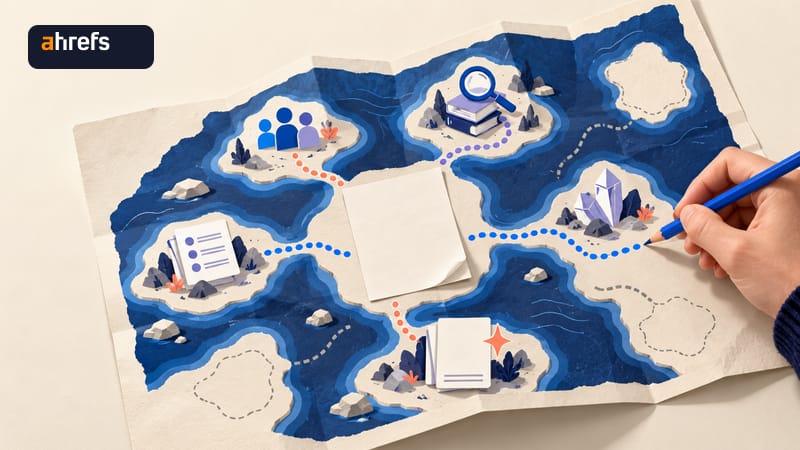
Featured image caption: A topic map shows which reader questions are answered, supported, or still open.