

 Bonani DOSH, Dhaka - 1230, Bangladesh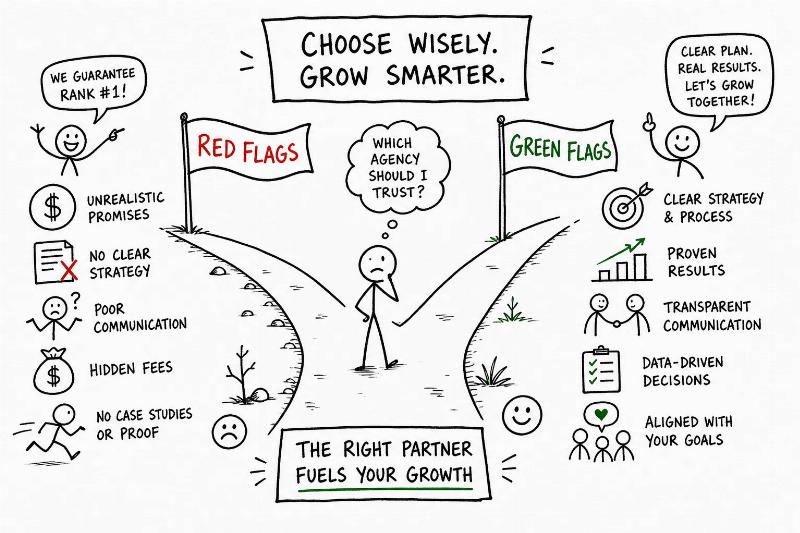

Digital Marketing Agency Red Flags and Green Flags Every Founder Should Know
Six months in. Thousands of dollars spent. And the agency just sent over another report packed with impressions, reach, and "growing brand awareness." No new leads. No uptick in revenue. No clear explanation of what they actually changed last month or what they plan to do next. If that scenario sounds familiar, you are not alone. It is one of the most common reasons founders eventually fire their agency, and the frustrating part is that the warning signs were there from the beginning. This guide covers the digital marketing agency red flags and green flags for founders who want to stop wasting budget and start choosing partners who actually drive results.
Most founders do not know what to look for until they have already lost budget and momentum. The agency sales process is designed to feel trustworthy. Polished decks, confident strategists, past-client name-dropping, none of that tells you whether the agency will actually grow your business. What does tell you is knowing the specific behaviors, standards, and contract terms that separate real partners from retainer collectors.
Agencies like Make Anything Simple (MAKE) have built their operating model around what you are about to read: transparent KPIs agreed on before work starts, educational client communication that keeps founders informed rather than dependent, and direct data access that never gets withheld. MAKE states these are not perks but baseline standards, expectations every founder should hold any agency to. This article gives you a founder-to-founder breakdown of the red flags and green flags to evaluate before signing anything, along with eight interview questions and the contract clauses that should give you pause.
Digital marketing agency red flags for founders
These are not edge cases. They are the most common reasons founders fire agencies after months of wasted spend. Each red flag below carries a direct financial consequence, and collectively they account for a majority of founder-agency breakdowns reported across small business research.
Vague reporting that hides what is actually happening
When a monthly report is full of impressions, reach, and "engagement" with no connection to leads, revenue, or pipeline, that is not an innocent gap. Vanity metrics are easy for agencies to generate and genuinely difficult for founders to act on. A legitimate report tells you what changed, why it changed, and what the agency is doing next based on that data. If the only number that climbs every month is "brand awareness," your budget is paying for the agency's comfort, not your growth.
Opaque reporting is a leading reason founders leave agencies. The Australian Small Business and Family Enterprise Ombudsman (ASBFEO) found that roughly 32.8% of small businesses ended up in formal disputes with their digital marketing provider, with lack of open and honest communication cited as the core driver. Multiple founder surveys echo the same finding: when clients cannot connect spend to outcomes, the relationship breaks down. If you cannot read a report and answer "what did this spend produce," something is being hidden from you.
No strategy calls, just a stream of deliverables
When an agency only shows up to send invoices and deliver content assets, there is no accountability loop in place. Real strategy requires regular conversations where the agency connects its work directly to your business goals, not just its contractual scope of work. Deliverables without dialogue means you are buying output, not outcomes.
Cookie-cutter packages with your name swapped in
If the agency pitched you the same package they pitch every client, identical deliverables and no visible research into your market, customer, or funnel, that is a warning you should take seriously. Generic strategy produces generic results. A real agency asks about your sales cycle, your average deal size, your existing content, and your current conversion points before recommending anything. If none of those questions came up during the pitch, the proposal was already written before you said a word.
Green flags for founders hiring a digital marketing agency
A green-flag agency is not simply one that avoids the bad behaviors above. It actively earns trust through how it communicates, prices, and reports. Look for these behaviors specifically, not just the absence of red flags.
Transparent pricing and KPIs agreed on before work starts
Green-flag agencies give you clear pricing with no hidden markups on ad spend. More importantly, they propose a focused set of KPIs, typically five to eight, tied directly to your business goals before the first month begins. No surprises in month three when you realize the metrics they have been optimizing for have nothing to do with your revenue. A well-scoped engagement should have agreed-upon success criteria before any work is in flight.
An educational approach that keeps founders in control
The best agency partners teach as they build. They explain what they are doing, why the strategy makes sense, and what the data means for your next decision. Clients should never be left guessing what their budget is doing or why a particular tactic was chosen. When you finish a monthly call with your agency feeling more informed than when you started, that is a green flag worth noting. When you finish feeling more confused, that is a systemic issue that compounds over time.
Direct access to your accounts, data, and dashboards
A trustworthy agency gives you admin access to your own ad accounts, Google Analytics setup, and any dashboards they build for your campaigns. You should be able to log in and verify spend, pacing, and changes at any time. If an agency holds your data behind a PDF summary or resists giving you account access, that is not a process preference. It is a structural problem that will cost you when the relationship ends.
Contract clauses that should stop you from signing
Most founders skim the contract and sign fast because the sales conversation went well. That is where the real traps live. These specific clause types put founders at genuine financial and operational risk.
Auto-renewals and long minimum commitments
Auto-renewal clauses are structured so the contract keeps rolling for the same initial term unless you provide written notice of cancellation within a narrow window, often 30 to 90 days before renewal. A 12-month contract with a 60-day non-renewal notice requirement means you effectively need to decide whether to continue at month 10. Miss that window and you are committed for another full year. As a practical benchmark, and this is advisory rather than a universal rule, a three-month initial engagement with a reasonable exit option gives both sides enough time to evaluate fit without trapping either party for a full year if results do not materialize.
Who owns your accounts, assets, and work product when you leave
Some agencies retain ownership of creative assets, ad account structures, or website builds when the relationship ends. Everything built on your budget should belong to you. Look specifically for language that assigns intellectual property rights to the agency, or clauses that make deliverables contingent on the completion of the full contract term. Before signing, confirm in writing that all accounts, creative files, website code, tracking setups, and data exports transfer to you upon termination, regardless of how the relationship ends.
Termination fees and exit penalties buried in the fine print
Early termination fees, kill fees, and clauses that make leaving expensive regardless of performance are common in agency contracts. A fair agency does not need a financial trap to retain clients. If the contract makes it costly to leave when results are poor, that clause is not protecting the agency's legitimate interests. It is protecting their revenue from accountability. Read every section labeled "termination," "cancellation," "early exit," and "fees upon termination" before you sign.
Eight interview questions that cut through the sales pitch
The discovery call is your one chance to stress-test an agency before money changes hands. Generic questions get polished, rehearsed answers. The questions below are designed to surface real behavior, not talking points.
Questions that reveal how they handle transparency and bad news
- "Walk me through a time a campaign significantly underperformed." What happened, when did they realize it, and how did they communicate it to the client?
- "What information do you proactively share with clients, and what do you deliberately keep internal?"The best agencies answer without hesitation. The ones who pause or get vague are telling you something important.
- "Describe a time you had to admit a mistake that affected a client's results. What exactly did you say, and how quickly did you say it?" Specific, detailed answers signal real accountability. Polished non-answers signal the opposite.
Questions that reveal how they track, attribute, and report results
- "Which attribution model do you use by default, and when do you change it?" A clear, confident answer indicates methodological discipline.
- "How do you handle discrepancies between platform-reported results and our CRM or analytics data?" Agencies without a clear process for reconciling data will leave you with numbers that do not add up.
- "Will I have direct admin access to my ad accounts, or will reporting come as a PDF summary?" The answer should be direct access, always. An agency that cannot clearly explain its attribution model is either not sophisticated enough or not interested in being held accountable by real data.
Questions that test real experience in your specific market
Ask for a comparable client in your industry, the specific goals they worked toward, and one campaign that failed and why. Follow up with: "What industry-specific constraints or customer behaviors did you have to account for?" Generic answers to any of these questions are a red flag by themselves. Real industry experience produces specific, sometimes uncomfortable answers about what did not work and why.
The proof you should demand before writing any check
Interview answers are easy to polish. Actual proof is harder to manufacture. Before you move to a contract, request these specific artifacts from every agency you are seriously considering.
Case studies with real numbers, not just client logos
A legitimate case study includes the starting baseline, the strategy and channels used, the time frame, and the measurable outcome expressed in leads, ROAS, traffic growth, or revenue. Logo walls and vague "we scaled their brand" summaries are not proof. When numbers are missing from a case study, ask directly: "What was the starting conversion rate, and where did it end up after your engagement?" If the agency cannot answer that question for a client they are actively promoting as a success story, that case study exists for aesthetics, not accountability.
Reference checks and a live dashboard walkthrough
Reference checks should include at least one client who ended the engagement, not only current happy clients. Ask references specific questions: "How did the agency communicate during periods when results were down? Did you always have access to your own data? What would you have changed about the relationship?" For the dashboard walkthrough, ask the agency to show you a real reporting example from an active account and explain what the data drove them to do differently. An agency that can walk you through data and connect it to a specific decision they made is showing you real operational competence, not a polished visual.
Protecting your budget starts before you sign
Hiring a digital marketing agency is a business decision with real financial stakes. Founders who go into that process with a clear checklist, the right questions, and contract awareness protect their budget far better than those who rely on referrals and gut feel alone. The signals are almost always present during the sales process. An agency that avoids your questions about reporting, gets vague about data access, or rushes you past the contract details is likely to behave exactly the same way when it is managing your money.
Agencies that operate transparently, report honestly, and educate their clients rather than keeping them dependent do exist, and they are worth holding out for. Make Anything Simple (MAKE) was built on exactly these standards: clear KPIs before work starts, direct client access to all accounts and data, and a framework-driven approach that keeps founders informed at every stage, not just at billing time.
FAQ
Q: What are the most common red flags that a digital marketing agency is underperforming?
A: Common red flags include vague reports focused on impressions and reach instead of leads or revenue, no regular strategy calls (only deliverables), cookie-cutter packages with no market or funnel research, and a failure to explain what changed and what they’ll do next. These behaviors usually lead to wasted budget and stalled growth.
Q: How can I tell if an agency's reporting is meaningful or just vanity metrics?
A: Meaningful reporting ties spend to outcomes: it explains what changed, why it changed, and the next steps based on that data, with clear links to leads, pipeline, or revenue. If reports only show impressions, reach, or engagement with no connection to business results, those are likely vanity metrics.
Q: What green flags should founders look for when choosing a digital marketing agency?
A: Green flags include transparent KPIs agreed on before work starts, educational client communication that keeps founders informed, direct data access that isn’t withheld, regular strategy calls, and a tailored approach that asks about your sales cycle, deal size, and conversion points. Agencies like Make Anything Simple (MAS) treat these as baseline standards.
Q: Why is an agency that only delivers assets without strategy calls a problem?
A: Deliverables without dialogue mean there’s no accountability loop tying work to your business goals, so you’re buying output rather than outcomes. Regular strategy conversations are necessary for the agency to interpret results, adjust tactics, and demonstrate impact on pipeline and revenue.
Q: Which contract clauses should make a founder pause before signing?
A: Be wary of long lock-in terms with no exit or performance triggers, clauses that limit your access to data, vague scopes of work that allow endless add-ons, and automatic renewals with no KPI-based review. Those terms shift risk to you and make it hard to hold the agency accountable for results.
Q: What interview questions should I ask a prospective agency to evaluate fit?
A: Ask how they measure and report leads and revenue, which KPIs they’ll commit to, how often you'll meet for strategy, whether you’ll get direct data access, how they tailor strategy to your sales cycle, and for case studies from similar businesses. These questions reveal whether they focus on outcomes or just repeat a standard package.
Q: How common are disputes between small businesses and digital marketing providers?
A: Disputes are relatively common: the Australian Small Business and Family Enterprise Ombudsman (ASBFEO) found roughly 32.8% of small businesses ended up in formal disputes with their digital marketing provider, with lack of open and honest communication cited as the core driver. Multiple founder surveys report the same breakdown: unclear connection between spend and outcomes is a frequent relationship-killer.