

 Bonani DOSH, Dhaka - 1230, Bangladesh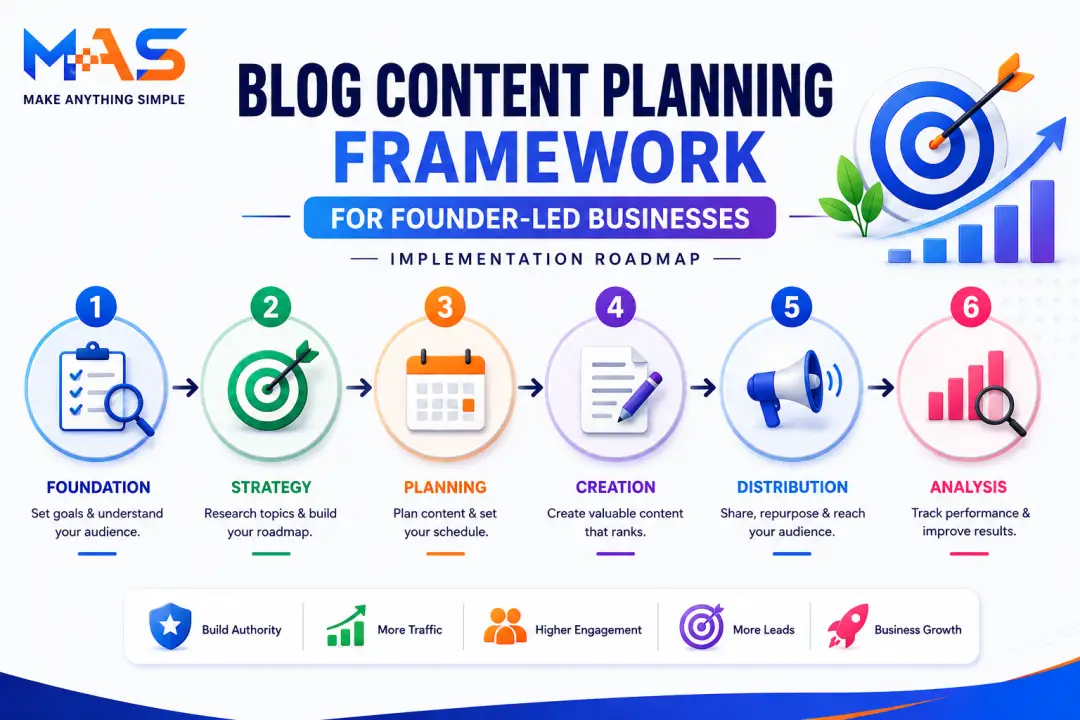

Blog Content Planning Framework for Founder-Led Businesses: Implementation Roadmap
For many founder-led businesses, the blog starts with good intentions but quickly becomes inconsistent. A few posts are published when there is time, topics are chosen randomly, and the blog slowly turns into a collection of disconnected updates instead of a serious growth asset.
The problem is usually not a lack of ideas. Founders often have more ideas than time. They answer customer questions every day, explain services on sales calls, solve client problems, review proposals, and make strategic decisions from real experience. But that knowledge often stays hidden inside calls, chats, documents, and internal conversations.
A strong blog content planning framework turns that founder knowledge into searchable, useful, and repeatable content assets. Instead of publishing random posts, you build a system that supports SEO, AI search visibility, customer education, internal linking, sales conversations, and long-term authority.
This roadmap is designed to move founder-led businesses away from the “random act of blogging” and toward a strategic content operation. By implementing a disciplined approach to blog content creation, you can improve search visibility, build trust with ideal clients, shorten the sales cycle, and create content that supports real business growth. If your internal resources are limited, reviewing professional content creation pricing can help you decide whether to delegate content production while keeping your brand voice consistent.
Establishing the Strategic Foundation for Content Success
Before you draft a single sentence, you need to define the “why” behind your content. Many founders write about what they personally find interesting instead of what prospects are actually searching for. That creates content that may sound thoughtful but does not support traffic, authority, leads, or sales.
A sustainable content engine starts by aligning your editorial calendar with your business growth objectives. If you have already built your website foundation through a business website planning checklist, your blog should become the primary vehicle for sending qualified traffic to those core service pages.
The first step is identifying your content pillars. These are the three to five core topics where your business has deep expertise and where your audience has important questions. By focusing your blog content creation around these pillars, you avoid scattered publishing and build topical authority over time.
Google’s own guidance emphasizes helpful, people-first content that demonstrates expertise, experience, authoritativeness, and trustworthiness. That means founder-led businesses should not only produce keyword-focused articles; they should publish content that reflects real knowledge, practical experience, and useful answers. You can review Google Search Central’s guidance on helpful content for more detail.
To build the strategic foundation, focus on these steps:
-
Map content to the buyer journey: Categorize your ideas into Awareness, Consideration, and Decision stages so each article has a clear purpose.
-
Audit your sales conversations: Review the questions prospects ask during discovery calls. These are often your strongest blog topics because they reflect real buyer friction.
-
Define your unique perspective: As a founder, your advantage is your direct experience. Avoid generic industry commentary and focus on practical lessons, opinions, frameworks, and examples from real business situations.
-
Align content with revenue goals: Every article should guide the reader to a useful next step, whether that is your services page, a related guide, or your contact form.
This foundation ensures that every hour spent writing contributes to your long-term business growth. The goal is not to publish the highest number of posts. The goal is to publish the most relevant, useful, and strategically connected content for your ideal clients.
Why Blog Content Creation Matters Now
In a digital landscape filled with AI-generated content, founder-led insight is becoming more valuable. Buyers are more skeptical, more informed, and more likely to research independently before contacting a business. If your company is not answering their questions, another brand will.
The risk of neglecting your blog is not only losing traffic. It is losing the opportunity to shape how prospects understand your expertise, your process, and your value. Without helpful content, your business can feel like a black box. Prospects cannot evaluate your thinking, compare your methodology, or build trust before speaking with you.
When you rely only on paid ads, referrals, or cold outreach, you are depending on channels that may be limited, expensive, or inconsistent. Blog content creation gives you an asset you own. A strong article can continue attracting visitors, educating buyers, and supporting sales conversations long after it is published.
The opportunity cost of random blogging is also significant. Founders may spend hours writing posts that do not match their services, do not support the sales funnel, and do not attract the right audience. A structured content framework prevents that waste.
When a prospect lands on a well-structured article that directly addresses their pain point, they are not only reading. They are being educated, qualified, and prepared for a better buying decision. They may learn your philosophy, compare service value, understand your process, or explore your content creation pricing when they are ready to delegate.
Founder-led content also supports E-E-A-T because it can show real experience. Your service offerings can be copied, but your specific perspective, frameworks, examples, and client lessons are harder to replicate. This is why founder-led content should not sound generic. It should reflect real business thinking.
Consider the compounding effect. If you publish one high-impact article every two weeks, you create 26 strong assets in a year. If those articles are connected to your agency or consulting planning guide, your blog becomes a library of pre-sales material that supports discovery calls, follow-ups, internal linking, and long-term search authority.
The goal is to move away from the feast-or-famine cycle of lead generation and create a content system that works consistently. When you focus on the intersection of what your audience needs and what you are uniquely qualified to teach, content becomes a business development engine instead of a publishing chore.
Understand the Buyer Journey and Search Intent
Effective content planning starts with understanding the reader’s current situation. A founder-led strategy works best when each article matches the psychological stage of the buyer.
If you try to sell a high-ticket service to someone who is still trying to understand their problem, the content will feel too aggressive. If you only publish educational content and never guide readers toward a decision, your blog may get traffic but not leads.
That is why every article should map to one of three stages: Awareness, Consideration, or Decision.
The Awareness Stage: Defining the Problem
At the Awareness stage, the prospect feels a pain but does not fully understand the cause. They are searching for broad, symptom-based answers. They are not ready for a sales pitch. They need clarity.
Example: If you run a web development agency, an Awareness-stage reader might search for “why is my website conversion rate dropping?” They are not ready to compare web development pricing yet. They are worried about losing leads or sales. An article like “5 Common Reasons Your Website Traffic Is Not Converting” can educate them, build trust, and introduce your expertise without pressure.
The Consideration Stage: Evaluating Solutions
At the Consideration stage, the prospect understands the problem and is comparing ways to solve it. They may be comparing tools, strategies, agencies, freelancers, templates, or internal hiring options.
Example: A reader may search for “how to optimize a business website for lead generation.” This is a good moment to introduce a structured guide, such as the Business Website Planning Checklist. By showing a practical framework, you help the reader understand how professionals approach the work.
The Decision Stage: Choosing the Partner
At the Decision stage, the prospect is close to action. They want pricing, process, proof, scope, timeline, and service details. They are evaluating whether you are the right fit.
Example: A prospect may search for “web design agency for small businesses” or “how much does professional web development cost.” At this stage, linking to web design pricing is useful because the reader is looking for clarity before making contact.
Mapping Intent to Search Behavior
Search intent is the “why” behind a search. It explains whether the reader wants to learn, compare, or take action. Google Search Central explains that content should be created primarily for people, not search engines. You can review the Google Search Central SEO starter guide for foundational guidance.
| Stage | Prospect's Mindset | Content Goal | Example Topic |
|---|---|---|---|
| Awareness | I have a problem, but I do not know why. | Build authority and trust. | Why your current marketing is not scaling. |
| Consideration | I know the problem; what are my options? | Compare solutions and explain methodology. | In-house vs agency: which is better for growth? |
| Decision | I want to hire someone to fix this. | Remove friction and guide action. | How our content planning process works. |
When your content covers all three stages, your blog can support the full buyer journey—from first problem awareness to final inquiry.
Build the Core Strategy Framework
After mapping the buyer journey, you need a repeatable system for turning ideas into content assets. Many founders fail at blog content creation because they treat each post as an isolated task. A better approach is to build a library of connected resources.
The following framework has four phases: audit, plan, produce, and improve.
Phase 1: Content Audit and Gap Analysis
Before writing new articles, review what already exists. Many founder-led businesses have scattered blog posts that lack a cohesive narrative. Some articles may be useful but outdated. Some may target the wrong intent. Some may need better internal links.
Start by categorizing existing content into Awareness, Consideration, and Decision stages. Then identify the gaps. If you have many Awareness articles but no Decision-stage content, your blog may attract readers without giving them a clear path toward inquiry.
Use the audit to create a content backlog. Prioritize topics that support your business goals, service pages, and high-intent buyer questions.
Phase 2: Founder-Voice Editorial Calendar
Consistency is difficult for founders because daily business demands often interrupt content plans. The solution is not simply writing more. The solution is writing smarter with a practical editorial calendar.
A simple 90-day calendar can follow a 2-2-1 ratio:
-
Two Awareness articles
-
Two Consideration articles
-
One Decision article
This keeps your content balanced. You build the top of the funnel while also supporting readers who are closer to buying.
When planning topics, focus on your proprietary perspective: the frameworks, mistakes, lessons, and service methods that make your business different.
Phase 3: Production Workflow
To keep blog content creation efficient, treat each article like a small project. Do not sit down and try to create everything at once.
-
Outline: Define search intent, target reader, main promise, and call-to-action.
-
Draft: Get the founder’s expertise onto the page through notes, voice recording, or direct writing.
-
Optimize: Improve headings, add internal links, include examples, and make the structure easier to scan.
-
Refine: Add a natural next step, such as a relevant guide, pricing page, or contact page.
Phase 4: Measurement and Iteration
You cannot improve what you do not measure. Use analytics to understand which posts generate impressions, clicks, internal link visits, and conversions.
If an article gets impressions but few clicks, improve the title and meta description. If an article gets traffic but no inquiries, improve the internal links and next-step guidance. If an article is outdated, refresh it instead of ignoring it.
Practical Application: The Content Pillar Strategy
To maximize the impact of blog content creation, use the pillar-cluster model. A pillar is a comprehensive guide that covers a broad topic in depth. Cluster articles are smaller posts that answer specific questions connected to that pillar.
Every cluster article should link back to the pillar page, and the pillar page should link to relevant cluster articles. This creates a connected web of content that helps readers and search engines understand your authority.
For example, if your pillar is “Small Business Growth,” your cluster articles might include specific topics such as how to fix tracking errors, website planning, SEO strategy, content systems, or paid advertising workflows.
This approach ensures that you are not just creating content. You are building an ecosystem that guides prospects from their first question to a stronger buying decision.
Turn the Strategy Into a Repeatable Workflow
A strategy is only valuable if you can execute it consistently. Many founders struggle with content because they try to brainstorm, outline, write, edit, optimize, and publish in one sitting. That creates pressure and slows the process.
The better approach is to separate thinking from doing.
The Weekly Content Sprint
A weekly content sprint breaks the process into small, manageable roles. Even if you are working alone, use these roles at different times.
-
The Strategist: Select one topic from the content backlog and define the search intent, target keyword, and primary CTA.
-
The Subject Matter Expert: Record a quick voice note or video explaining the topic from your experience.
-
The Editor: Turn the raw input into a structured article with headings, examples, and internal links.
-
The Publisher: Upload the post, add metadata, check the URL, format tables, and schedule publication.
Establishing a Review Cycle
Content that is not reviewed eventually decays. Set aside time every quarter to perform a content health check. Use Google Analytics to identify which posts are attracting traffic and which posts are driving conversions.
If a post gets traffic but does not create movement toward your services, the CTA or internal link path may be weak. Check whether the article links to the right next step, such as your pricing pages, related guides, or contact form.
Maintain a strict “No-Go” list. If a topic does not serve your buyer persona, content pillar, or business objective, do not publish it just because it is trending.
Operationalizing Roles
If you have a team, the founder should not handle every step. The founder’s most valuable role is providing strategy and expertise. The team can support research, drafting, editing, optimization, formatting, and publishing.
| Role | Primary Responsibility | Output |
|---|---|---|
| Founder | Strategy and expertise | Raw insights and topic direction |
| Content Coordinator | Research and drafting | First draft |
| SEO Specialist | Optimization and linking | SEO-ready final version |
| Publisher | CMS formatting and scheduling | Published article |
By formalizing the workflow, you stop relying on motivation and start relying on a process. This allows your blog to support lead generation and brand authority while the founder focuses on high-value business work.
Connect Content, SEO, and Internal Links
Your blog is not a storage space for random thoughts. It is a strategic asset designed to move prospects through a journey. If your posts exist in isolation, you miss one of the most important SEO and conversion opportunities: internal linking.
Think of your website as a physical office. If a potential client enters through a blog post, they should not be left wandering. Internal links act as clear signs that guide them to related resources, pricing pages, service pages, and contact options.
The Pillar-Cluster Architecture
A pillar is a comprehensive high-level guide, such as the Agency & Consulting Planning Guide for Business Growth. Around that pillar, you create cluster content that answers specific questions connected to the broader topic.
For example, a business growth pillar may link to articles about website planning, content creation, tracking setup, online advertising, SEO, and service pricing. This helps readers explore related topics and helps search engines understand the relationship between pages.
Connecting Content to Service Pages
One of the biggest mistakes founder-led businesses make is writing useful content that never connects to services. If a reader finds value in your advice, they may naturally want to understand how your business can help them implement it.
Use contextual links where they feel helpful. For example, if you are writing about the importance of a well-structured website, you can naturally guide readers to review web design pricing. If the article discusses technical delivery, you may link to web development pricing.
If you are discussing organic visibility, link to SEO solutions. If the article explains paid traffic or campaign planning, link to online advertising. These links should feel like useful next steps, not forced sales pitches.
Best Practices for Internal Linking
-
Use descriptive anchor text: Avoid generic text like “click here.” Use clear phrases such as “content creation pricing,” “web design pricing,” or “SEO solutions.”
-
Prioritize the reader’s next step: Ask what the reader would logically need after finishing this section.
-
Link from old posts to new pillar content: This helps newer strategic pages receive more internal authority.
-
Link from pillar pages to supporting content: This helps users explore deeper topics.
-
Audit links regularly: Broken or outdated links create a poor user experience and should be fixed during quarterly content reviews.
When content, SEO, and internal links work together, your blog stops being a collection of posts and becomes a connected business development system.
Content Planning Checklist for Founder-Led Businesses
Use this checklist before publishing any blog post:
-
Business goal is clear
-
Target audience is defined
-
Search intent is identified
-
Buyer journey stage is clear
-
Content pillar is selected
-
Title is specific and useful
-
Introduction explains the problem quickly
-
Founder insight is included
-
Examples or tables are added
-
Relevant internal links are included
-
External source links are useful and trustworthy
-
Meta title and description are written
-
Thumbnail image is ready
-
FAQ section is included when useful
-
Article is reviewed for readability
-
Article is submitted for indexing after publishing
Common Blog Planning Mistakes to Avoid
-
Writing without a business goal: Every article should support authority, education, traffic, leads, or sales.
-
Ignoring search intent: If the content does not match what the reader wants, it will struggle to perform.
-
Publishing disconnected topics: Random topics do not build topical authority.
-
Forgetting internal links: Without links, readers may not know what to read or do next.
-
Writing only for traffic: Traffic matters only when it attracts the right people.
-
Removing founder perspective: Generic content is easy to copy. Founder insight makes the article more valuable.
-
Never updating old posts: Content can lose rankings and trust if it becomes outdated.
-
Using weak titles: A vague title can reduce clicks even if the article is useful.
FAQ: Blog Content Planning Framework
What is a blog content planning framework?
A blog content planning framework is a structured system for choosing topics, mapping search intent, organizing content pillars, creating an editorial calendar, publishing articles, measuring results, and updating content over time.
Why do founder-led businesses need blog content?
Founder-led businesses need blog content because it turns real expertise into searchable assets that build trust, answer buyer questions, support sales, and improve organic visibility.
How often should a founder-led business publish blog posts?
A founder-led business can start with one strong article every one or two weeks. Quality and relevance matter more than publishing weak posts frequently.
What should founders write about?
Founders should write about customer problems, pricing questions, service comparisons, mistakes to avoid, buyer guides, project lessons, and practical frameworks based on real experience.
What is a content pillar?
A content pillar is a major topic your business wants to be known for. Supporting articles are created around that topic to build topical authority and improve internal linking.
How does blog content help SEO?
Blog content helps SEO by targeting relevant search queries, answering user questions, building topical depth, supporting internal links, and improving authority around important services.
Should old blog posts be updated?
Yes. Updating old posts can improve rankings, add freshness, strengthen internal links, remove outdated information, and make the content more useful for readers.
How can blog content generate leads?
Blog content can generate leads by attracting the right audience, answering their questions, linking to relevant services, explaining solutions, and guiding readers toward a contact form or pricing page.
Final Thoughts
Blog content works best when it is planned, not guessed. Founder-led businesses have a powerful advantage because they hold real experience, customer insight, and practical knowledge that generic content cannot copy.
The key is to turn that expertise into a repeatable system.
Start with your business goals. Define your content pillars. Map topics to the buyer journey. Understand search intent. Capture founder insights. Add internal links. Measure results. Refresh old content.
When content is created this way, your blog becomes more than a publishing channel. It becomes a long-term authority asset that supports organic traffic, AI search visibility, sales conversations, customer education, and business growth.