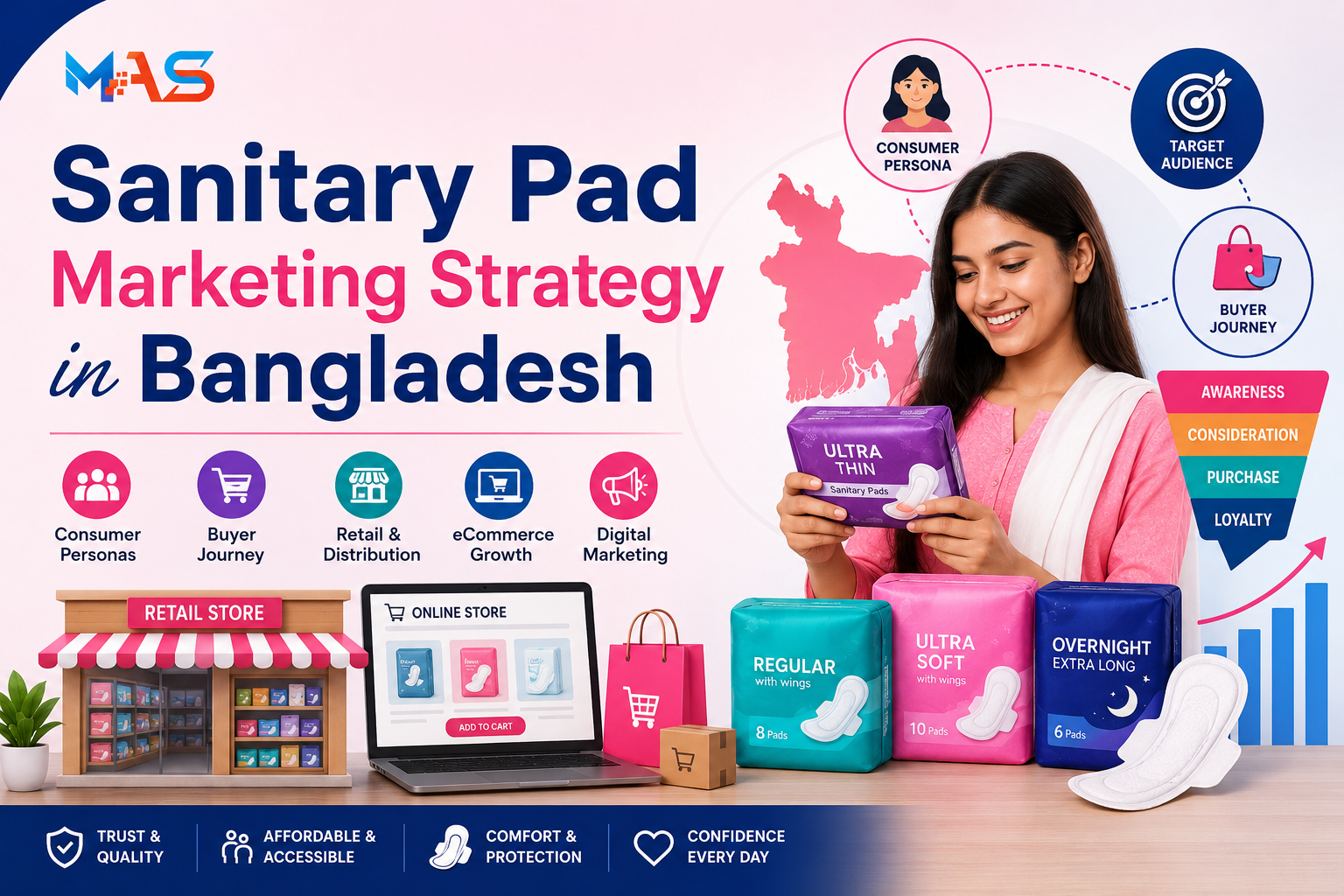
Sanitary Pad Marketing Strategy in Bangladesh: Consumer Journey, Buyer Personas, and Digital Growth Guide
The sanitary pad and period care market in Bangladesh is not a normal FMCG category. It is emotional, private, health-related, price-sensitive, and deeply shaped by culture, education, trust, family influence, retail comfort, and access.
For marketers, this means a sanitary pad brand cannot grow only by showing product features or offering discounts. The brand must understand the full consumer journey: awareness, first use, purchase comfort, repeat buying, family approval, product trust, retail availability, and long-term loyalty.
Bangladesh has a growing opportunity for period care brands, but the market still has important barriers. Many consumers are aware of sanitary pads but may not use them regularly because of price, privacy, habit, limited availability, social discomfort, or lack of clear product education.
This guide explains how sanitary pad brands, FMCG companies, eCommerce sellers, distributors, and digital marketers can build a smarter marketing strategy for Bangladesh.
The goal is not only to sell more pads. The goal is to build trust, improve access, educate consumers, and create a brand that women feel comfortable buying again and again.
Why sanitary pad marketing in Bangladesh needs a different strategy
Sanitary pads are not purchased like snacks, cosmetics, or regular household items. The buying decision is private and often influenced by social sensitivity. A consumer may need the product every month, but still feel uncomfortable asking for it at a shop, discussing it openly, or comparing brands publicly.
This creates a unique marketing challenge.
A sanitary pad brand must solve several problems at the same time:
-
Build awareness without making the audience uncomfortable
-
Explain product benefits clearly and respectfully
-
Reduce embarrassment around purchase
-
Make products affordable for different income groups
-
Improve availability in local shops, pharmacies, supermarkets, and online platforms
-
Create trust among mothers, students, working women, and first-time users
-
Support repeat buying through product quality and convenience
-
Use digital platforms without violating privacy or cultural sensitivity
Unlike many product categories, sanitary pad marketing must combine education, trust, access, privacy, affordability, and emotional confidence.
In period care marketing, the strongest brand is often the one that makes the consumer feel safe, understood, and respected.
Understanding the Bangladeshi sanitary pad consumer
The sanitary pad consumer in Bangladesh is not one single audience. Different groups have different motivations, budgets, knowledge levels, product preferences, and buying barriers.
A strong marketing strategy starts with segmentation.
| Consumer Segment | Core Need | Main Barrier | Marketing Opportunity |
| Teenage girls | Comfort, confidence, guidance | Embarrassment, lack of knowledge, parent dependency | Educational content, school programs, mother-daughter communication |
| College students | Privacy, affordability, reliable protection | Budget sensitivity and social discomfort | Small packs, discreet retail, social media education |
| Working women | Long-hour comfort, leakage protection, convenience | Busy lifestyle and need for trusted quality | Premium positioning, subscription, office wellness campaigns |
| Mothers and homemakers | Family health, value for money, trust | Habit, price concern, limited product comparison | Family-safe messaging, bulk packs, pharmacy trust |
| Rural and semi-urban consumers | Access, affordability, basic education | Availability, price, taboo, male shopkeeper discomfort | Community distribution, female retailers, micro-packs |
| Online shoppers | Discreet purchase, convenience, product comparison | Delivery trust and product authenticity | eCommerce bundles, reviews, privacy-focused delivery |
Each segment needs a different message. A teenage girl may need education and reassurance. A working woman may need comfort and long-hour protection. A rural consumer may need access and affordability. An online buyer may need discreet delivery and product authenticity.
Trying to speak to all consumers with one message usually produces weak marketing.
The sanitary pad buyer journey in Bangladesh
The buyer journey for sanitary pads is more complex than many marketers realize. It is not simply “see ad, buy product.” The journey often includes awareness, emotional hesitation, family influence, product trial, purchase comfort, and repeat usage.
1. Awareness stage
At this stage, the consumer becomes aware of sanitary pads, a new brand, or a better product option. Awareness may come from school, friends, mother, older sister, TV advertising, pharmacy displays, Facebook content, YouTube videos, TikTok, influencer content, or health education campaigns.
The consumer may ask:
-
What product should I use?
-
Is this safe?
-
Which pad is comfortable?
-
How often should it be changed?
-
Which brand is trusted?
Marketing goal at this stage: educate and normalize the conversation respectfully.
2. Consideration stage
At this stage, the consumer compares brands, pack size, price, comfort, absorption, availability, softness, length, leakage protection, and product reviews.
Some buyers may compare products openly. Others may make the decision quietly based on what is available in the nearest shop or what family members already use.
Marketing goal at this stage: show clear product differences and reduce confusion.
3. Purchase stage
This is one of the most sensitive parts of the journey. Even if the consumer wants the product, she may feel uncomfortable buying it from a male shopkeeper or asking for a specific brand by name.
The purchase experience matters a lot. If the product is not available, too expensive, or difficult to request, the consumer may switch brands or use an alternative.
Marketing goal at this stage: make buying easy, private, and convenient.
4. Usage experience stage
After purchase, the product must perform well. If the pad is uncomfortable, causes irritation, leaks, moves, or does not match the promised quality, the consumer may not buy again.
Marketing goal at this stage: deliver product satisfaction and build trust.
5. Repeat purchase stage
Repeat buying is where long-term brand growth happens. Sanitary pads are recurring monthly products, so retention matters more than one-time trial.
Marketing goal at this stage: build routine, loyalty, and easy repurchase.
6. Advocacy stage
If a consumer trusts the product, she may recommend it to a sister, friend, daughter, colleague, or online community. In this category, word-of-mouth can be extremely powerful because trust is personal.
Marketing goal at this stage: turn satisfied users into quiet but strong advocates.
Key barriers that sanitary pad brands must solve
1. Price sensitivity
Affordability is one of the biggest barriers in Bangladesh. Even when consumers understand the value of sanitary pads, price can limit regular use.
Many buyers are not only asking, “Is this good?” They are also asking, “Can I buy this every month?”
Possible marketing and product solutions:
-
Small pack sizes for trial and low-income consumers
-
Value packs for regular users
-
Student-focused pricing
-
Bundle offers through eCommerce
-
Retail promotions around salary dates or seasonal campaigns
-
Affordable sub-brand strategy for rural and semi-urban markets
However, brands must be careful. Low price should not create a perception of low quality. In health-related categories, trust and safety matter as much as affordability.
2. Privacy and embarrassment
For many consumers, the hardest part is not using the product. It is buying the product.
Privacy-sensitive marketing can help reduce this barrier.
Useful strategies include:
-
Discreet packaging
-
Female-friendly retail points
-
Pharmacy-based availability
-
Online ordering with discreet delivery
-
Clear product display so consumers can point instead of asking verbally
-
QR code-based education on packaging
-
Community female reseller model in rural areas
Brands that make purchase easier can win consumers even before product comparison begins.
3. Habit and traditional alternatives
Some consumers continue using cloth or other alternatives due to habit, cost, family practice, or lack of awareness. Marketing must handle this respectfully.
The message should not shame consumers. Instead, it should explain hygiene, comfort, changing frequency, disposal, and convenience in simple language.
Good messaging focuses on:
-
Comfort during school, work, and travel
-
Confidence during daily activity
-
Clean and convenient use
-
Practical hygiene education
-
Mother-daughter guidance
4. Lack of product education
Many consumers may not fully understand the difference between product types.
For example:
-
Regular pad vs overnight pad
-
Heavy flow vs light flow
-
Winged vs non-winged pad
-
Ultra-thin vs cottony soft pad
-
Reusable vs disposable options
Brands should create simple comparison guides so consumers can choose the right product without confusion.
5. Limited availability
Availability is still a major growth factor. A consumer may see an ad but fail to find the product at the nearest shop. If distribution is weak, marketing spend becomes less effective.
Sanitary pad brands need strong availability across:
-
Local grocery shops
-
Pharmacies
-
Super shops
-
Beauty and personal care stores
-
School and college-adjacent retail points
-
Workplace wellness channels
-
eCommerce marketplaces
-
Brand-owned online store
For this category, distribution is not only logistics. It is part of customer comfort.
Buyer personas for sanitary pad brands in Bangladesh
Persona 1: The first-time student user
This user is young, often dependent on her mother or family for purchase, and may feel confused or shy. She needs guidance, comfort, and reassurance.
Best marketing message: “Feel prepared, comfortable, and confident.”
Best channels: School awareness programs, mother-focused content, educational videos, simple packaging instructions, youth-friendly social content.
Persona 2: The budget-conscious regular buyer
This consumer already understands sanitary pads but is very price-sensitive. She may switch brands based on offers, pack size, or availability.
Best marketing message: “Reliable protection at a price you can manage every month.”
Best channels: Retail promotions, small pack availability, value bundles, local shop campaigns, marketplace offers.
Persona 3: The urban working woman
This consumer values comfort, convenience, quality, and long-hour protection. She may be willing to pay more for a product she trusts.
Best marketing message: “Comfort and confidence for your busy day.”
Best channels: Facebook, Instagram, YouTube, search ads, workplace wellness partnerships, eCommerce subscriptions.
Persona 4: The mother decision-maker
Many mothers influence the product choices of teenage girls. They care about safety, value, reliability, and family trust.
Best marketing message: “Trusted care for your daughter’s comfort and hygiene.”
Best channels: TV, Facebook, community programs, pharmacy recommendations, educational content, family health messaging.
Persona 5: The discreet online shopper
This buyer prefers privacy and convenience. She may not want to buy from a local shop and may prefer delivery.
Best marketing message: “Order privately, receive comfortably, stay prepared.”
Best channels: eCommerce marketplaces, brand website, search ads, retargeting, WhatsApp ordering, subscription bundles.
Positioning strategy for sanitary pad brands
Positioning decides how consumers remember your brand. In Bangladesh, sanitary pad brands can position around different value drivers.
| Positioning Angle | Best For | Message Direction |
| Affordable care | Mass market, rural and semi-urban consumers | Reliable hygiene at a manageable monthly cost |
| Comfort and softness | Students, first-time users, sensitive-skin buyers | Gentle comfort for everyday confidence |
| Long-hour protection | Working women, students, travelers | Stay active without worry |
| Discreet convenience | Online shoppers and privacy-sensitive buyers | Easy private purchase and delivery |
| Education and empowerment | Awareness campaigns, school programs, CSR | Periods should not stop education, work, or confidence |
| Sustainable period care | Eco-conscious urban consumers | Reusable or responsible choices for long-term value |
A brand should not try to own every positioning at once. It should choose a clear identity and then build product, pricing, content, and distribution around that identity.
Product strategy: what consumers actually compare
Consumers compare sanitary pads based on both emotional and functional factors.
Common comparison points include:
-
Price per pack
-
Number of pads per pack
-
Softness
-
Absorption
-
Leakage protection
-
Length and thickness
-
Wings or no wings
-
Comfort during movement
-
Skin irritation concern
-
Odor control claim
-
Packaging privacy
-
Brand trust
-
Availability near home
-
Online reviews
Marketers should translate these features into clear benefits. Instead of only saying “high absorption,” explain the user benefit: “designed for longer protection during school, work, or travel.”
Simple, benefit-led messaging works better than complicated technical claims.
Pricing strategy for Bangladesh
Pricing is one of the most sensitive parts of sanitary pad marketing. The category has recurring demand, so long-term affordability matters.
A practical pricing strategy may include:
-
Trial pack: Small pack for first-time users or price-sensitive buyers
-
Regular pack: Standard monthly use pack
-
Value pack: Larger pack with lower per-unit cost
-
Premium pack: Higher comfort, overnight, ultra-thin, or special feature product
-
Bundle pack: Day and night combo
-
Subscription pack: Monthly eCommerce delivery
This allows the brand to serve multiple consumer groups without confusing the market.
For digital campaigns, pricing should be presented carefully. If a product is budget-friendly, communicate value and reliability. If it is premium, communicate comfort, protection, and confidence.
Retail strategy: winning at the point of purchase
Retail is extremely important for sanitary pads because many purchases are routine and urgent. If the preferred brand is not available, the consumer may buy another brand immediately.
Important retail strategies include:
-
Strong pharmacy presence
-
Clear shelf visibility
-
Small packs near checkout counters
-
Retailer education about product variants
-
Female-friendly purchase environments where possible
-
Discreet packaging and carry bags
-
Local shop incentives for availability
-
Sampling around schools, colleges, and offices through appropriate channels
Retailers are not only sellers. In many areas, they influence product availability, recommendation, and purchase comfort.
eCommerce strategy for sanitary pad brands
Online shopping can reduce embarrassment and improve convenience. For many urban consumers, eCommerce is a natural channel for period care products.
A strong eCommerce strategy should include:
-
Discreet delivery messaging
-
Monthly bundle offers
-
Subscription or repeat-order reminders
-
Clear product comparison images
-
FAQ section on product pages
-
Authentic customer reviews
-
Search-friendly product titles
-
Retargeting for repeat purchase
-
WhatsApp support for product selection
-
Fast delivery options in major cities
Product pages should answer common questions:
-
How many pads are in the pack?
-
Is it suitable for day or night?
-
Is it winged?
-
What is the size?
-
Who is it best for?
-
How should it be disposed of?
-
Is delivery discreet?
For eCommerce, clarity improves conversion rate. A confused buyer may leave without purchasing.
Digital marketing strategy for sanitary pad brands
Digital marketing can be powerful for sanitary pad brands, but it must be handled with sensitivity. The topic should be educational, respectful, and confidence-building rather than overly aggressive.
1. SEO strategy
Sanitary pad brands should create helpful content around real consumer questions.
SEO content topics may include:
-
How to choose the right sanitary pad
-
Day pad vs night pad: what is the difference?
-
How often should a sanitary pad be changed?
-
How to dispose of sanitary pads properly
-
Best sanitary pad for school or college students
-
Sanitary pad buying guide in Bangladesh
-
How to talk to your daughter about her first period
-
Period hygiene tips for working women
These topics can bring organic visitors and build brand trust over time.
2. Facebook and Instagram marketing
Facebook and Instagram are useful for awareness, education, product launches, offers, and retargeting.
Content ideas:
-
Short educational carousel posts
-
Mother-daughter guidance posts
-
Product comparison visuals
-
Myth vs fact content
-
Comfort and confidence stories
-
Retail availability announcements
-
Offer posts for monthly bundles
-
FAQ reels
Ad targeting should be responsible and privacy-conscious. Avoid messaging that feels intrusive or embarrassing.
3. TikTok and short video strategy
Short videos can work well for education and awareness if the tone is respectful.
Video ideas:
-
“How to choose the right pad size”
-
“Things every student should know about period care”
-
“Day pad vs night pad explained simply”
-
“How to prepare a period care pouch”
-
“Common period myths explained”
Short videos should not rely only on trends. They should build knowledge and trust.
4. Influencer marketing
Influencer marketing can help normalize the conversation, but the influencer must be chosen carefully.
Good influencer types include:
-
Women health educators
-
Lifestyle creators
-
Student-focused creators
-
Working women creators
-
Mothers and family content creators
-
Doctors or health professionals where appropriate and compliant
The best influencer content should educate, not just promote.
5. Search ads
Search ads can capture users with purchase intent.
Useful search intent keywords may include:
-
buy sanitary pad online Bangladesh
-
best sanitary pad in Bangladesh
-
overnight sanitary pad Bangladesh
-
soft sanitary pad price
-
sanitary napkin online order
-
period pad for school girls
Search ads should lead to specific product or category pages, not only the homepage.
Campaign ideas for sanitary pad brands
Campaign 1: First Period Confidence
This campaign targets teenage girls and mothers. The goal is to provide guidance, reduce fear, and support first-time users.
Content examples:
-
Beginner-friendly period care guide
-
Mother-daughter conversation tips
-
School emergency period pouch checklist
-
Simple pad usage and disposal education
Campaign 2: Stay Active Every Day
This campaign targets students and working women. The message focuses on comfort, movement, and confidence during daily life.
Content examples:
-
Long class day comfort tips
-
Office day period care checklist
-
Travel-friendly period care bundle
-
Day and night product comparison
Campaign 3: Private Monthly Delivery
This campaign targets online shoppers who want discreet purchase and convenience.
Content examples:
-
Monthly subscription bundle
-
Discreet delivery promise
-
Buy 2 months and save offer
-
Reminder-based repeat purchase campaign
Campaign 4: Period Myths vs Facts
This campaign focuses on education and trust-building.
Content examples:
-
Myth: Periods should not be discussed
-
Fact: Period health is normal and important
-
Myth: Any cloth is enough
-
Fact: Clean materials, regular changing, and safe disposal matter
Campaign 5: Retail Availability Drive
This campaign supports offline distribution.
Content examples:
-
“Now available near you” posts
-
Pharmacy partnership posts
-
Local area targeting ads
-
Retailer incentive campaign
Content strategy for long-term organic traffic
Sanitary pad brands can build strong organic traffic by publishing helpful, respectful, and practical content. The content should answer real questions and support purchase decisions.
| Content Type | Example Topic | Goal |
| Educational guide | How to use a sanitary pad properly | Build trust and help first-time users |
| Comparison article | Day pad vs night pad | Help product selection |
| Buyer guide | How to choose the best sanitary pad in Bangladesh | Capture search intent |
| FAQ article | Common period care questions | Support AI-search visibility |
| Product education | What does winged pad mean? | Reduce confusion |
| Parent guide | How mothers can support daughters during first period | Reach family decision-makers |
Every article should internally link to relevant product pages, bundles, or educational resources.
Trust signals that improve conversion
In this category, trust is critical. Consumers need to feel that the product is reliable, safe, comfortable, and suitable for their needs.
Useful trust signals include:
-
Clear product information
-
Real customer reviews
-
Doctor or health expert educational collaboration where appropriate
-
Quality assurance messaging
-
Transparent product details
-
Easy customer support
-
Discreet delivery promise
-
Return or complaint support policy
-
Educational FAQ page
-
Consistent brand tone
Trust cannot be built only through one campaign. It is built through consistent product quality, helpful communication, and reliable availability.
How to measure marketing performance
Sanitary pad marketing should be measured across both awareness and sales outcomes.
Important metrics include:
-
Reach and impressions
-
Video views
-
Engagement rate
-
Website traffic
-
Product page views
-
Add to cart
-
Online purchases
-
Repeat purchase rate
-
Subscription signups
-
Retail order volume
-
Shop coverage
-
Cost per acquisition
-
ROAS for eCommerce campaigns
-
Brand search growth
-
Customer reviews and sentiment
For eCommerce brands, tracking should include Meta Pixel, Conversions API, GA4, Google Tag Manager, purchase events, product IDs, and repeat purchase data.
For offline-heavy brands, sales team data, retailer coverage, area-wise stock movement, and campaign timing should be connected with digital campaign data.
Common mistakes sanitary pad brands should avoid
-
Only focusing on discounts: Price matters, but trust and comfort matter too.
-
Ignoring privacy: Purchase discomfort can reduce sales even when demand exists.
-
Using generic FMCG messaging: Period care needs sensitive, respectful communication.
-
Not educating consumers: Lack of clarity can stop trial and repeat purchase.
-
Weak retail availability: Advertising cannot work if the product is not easy to find.
-
Ignoring mothers and family influence: Many young consumers depend on family support.
-
Not separating consumer segments: Students, working women, rural consumers, and online buyers need different messages.
-
Poor product page content: eCommerce buyers need clear size, type, pack, and use-case details.
-
Not tracking repeat purchase: Recurring demand is the real growth engine.
A practical 90-day growth plan for sanitary pad brands
First 30 days: research and foundation
-
Audit current product positioning
-
Analyze consumer segments
-
Review retail availability
-
Check eCommerce product pages
-
Study competitor pricing and packaging
-
Prepare educational content plan
-
Set up Meta Pixel, GA4, GTM, and conversion tracking
Days 31-60: campaign launch
-
Launch awareness campaign
-
Publish educational blogs and FAQ content
-
Run product comparison ads
-
Test small pack and bundle offers
-
Start retargeting website visitors
-
Activate marketplace and eCommerce promotions
-
Collect customer reviews
Days 61-90: optimization and scaling
-
Analyze which segments are converting
-
Optimize creatives and landing pages
-
Improve product page FAQs
-
Scale best-performing campaigns
-
Build repeat purchase reminders
-
Expand retail area campaigns
-
Launch influencer or community education partnerships
This 90-day plan helps a brand move from awareness to measurable sales and repeat purchase.
Final thoughts
The sanitary pad market in Bangladesh has strong growth potential, but winning this category requires more than product promotion. Brands must understand the emotional, cultural, educational, and practical barriers that shape consumer decisions.
The most successful brands will be the ones that make period care easier to understand, easier to buy, easier to trust, and easier to repurchase.
For marketers, the opportunity is clear: combine respectful education, smart segmentation, affordable product strategy, strong retail distribution, eCommerce convenience, and accurate digital tracking.
A sanitary pad brand that supports confidence, privacy, health awareness, and accessibility can build both commercial success and meaningful social impact.
FAQ: Sanitary Pad Marketing in Bangladesh
What is the biggest challenge in sanitary pad marketing in Bangladesh?
The biggest challenge is not only awareness. Brands must also solve affordability, privacy, cultural sensitivity, retail availability, product trust, and repeat purchase barriers.
Who is the target audience for sanitary pad brands?
The target audience includes teenage girls, college students, working women, mothers, homemakers, rural consumers, semi-urban consumers, and online shoppers. Each group needs a different message and product strategy.
How can sanitary pad brands increase trust?
Brands can increase trust through clear product information, educational content, real reviews, consistent quality, discreet delivery, helpful customer support, and responsible health communication.
Is eCommerce important for sanitary pad brands?
Yes. eCommerce can help consumers buy privately and conveniently. Product pages should include size, pack details, use cases, FAQs, reviews, and discreet delivery information.
What type of content works best for sanitary pad SEO?
Helpful educational content works best, such as how to choose a sanitary pad, day vs night pad, period hygiene tips, first period guidance, disposal tips, and product comparison guides.
How should brands advertise sanitary pads on social media?
Social media campaigns should be respectful, educational, confidence-building, and privacy-conscious. Brands should avoid overly aggressive or embarrassing messages.
What is the best campaign angle for new sanitary pad users?
The best angle is confidence and guidance. First-time users need simple education, reassurance, comfort, and family-friendly messaging.
How can brands improve repeat purchase?
Brands can improve repeat purchase through product quality, monthly bundles, subscription offers, reminder campaigns, eCommerce retargeting, and consistent retail availability.